H.J.Res. 25 explained · 119th Congress · Became law
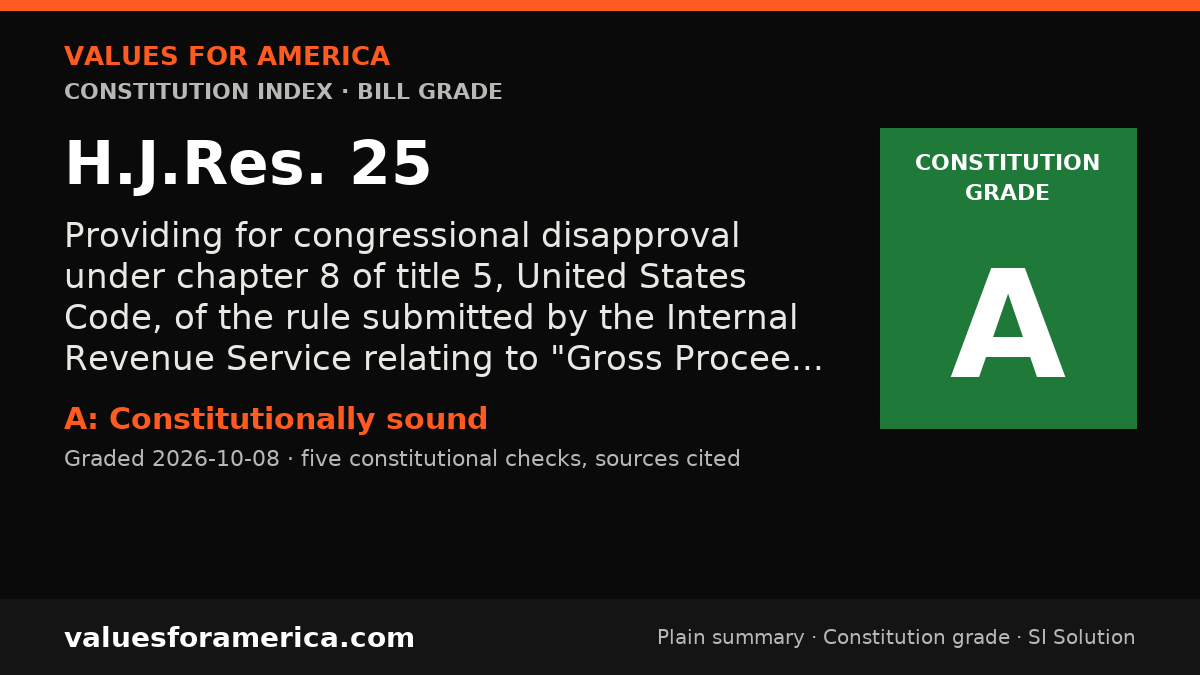
Providing for congressional disapproval under chapter 8 of title 5, United States Code, of the rule submitted by the Internal Revenue Service relating to "Gross Proceeds Reporting by Brokers That Regularly Provide Services Effectuating Digital Asset Sales".
Cosponsors: 9 (1 D, 8 R) · per Congress.gov, 2026-10-11
Introduced: 2025-01-21
Latest action (2025-04-10): Became Public Law No: 119-5.
What H.J.Res. 25 does, in plain terms
This joint resolution nullifies requirements for persons effectuating decentralized financial (DeFi) transactions to report certain information regarding digital asset sales to the Internal Revenue Service (IRS). Specifically, the joint resolution nullifies the requirements included in the rule titled Gross Proceeds Reporting by Brokers That Regularly Provide Services Effectuating Digital Asset Sales and issued by the IRS on December 30, 2024. Decentralized finance refers to the suite of financial activities and services that are facilitated by cryptocurrency and intended to be conducted without any sort of reliance on traditional financial tools or intermediaries.
Official summary by the Congressional Research Service, via Congress.gov.
Constitution Index
“VFA Constitution grade”
Constitutionally sound
Graded 2026-10-08
SI-generated grade · five published checks · not individually reviewed by a person · methodology
SI review: HJRES 25 repeals an IRS broker-reporting rule for decentralized transactions through lawful congressional disapproval. It stays inside enumerated tax and legislative powers, lessens search, speech-association, and sovereignty burdens, and reverses federal consolidation. No new mandate or taking is created.
-
✓ Passes · Enumerated powers
Congress acts within explicit authority: Article I, Section 8, Clause 1 taxing power to define reporting duties, Article I, Section 7 presentment for joint resolutions, and 5 U.S.C. chapter 8 disapproval procedure. It restrains rather than expands executive lawmaking and respects limits on delegation. -
✓ Passes · Bill of Rights
Nullifying the rule reduces Fourth Amendment tension by limiting compelled collection of transaction records linked to persons without individualized suspicion, and eases First Amendment associational privacy concerns around peer-to-peer software use. Fourth Amendment; First Amendment; Fifth Amendment due process liberty interest. -
✓ Passes · Individual sovereignty
The measure expands sovereignty by removing a restriction on use of property, labor, and voluntary exchange through decentralized software. Government bore the burden to justify deputizing software intermediaries as brokers; the SI review finds that burden unmet, so repeal restores freedom of contract and belief-neutral commerce. -
✓ Passes · Decentralization
Disapproval moves decision-making downward by removing a federal compliance layer on decentralized protocols. Individuals can transact and keep records, local commerce can function, states retain tax enforcement tools, and no new upward consolidation occurs; it reverses consolidation. -
✓ Passes · Due process and takings
The resolution imposes no penalty, seizure, or property taking and requires no hearing. It removes a reporting mandate that threatened warrantless financial dossier-building inconsistent with procedural due process and the presumption against arbitrary action under the Fifth Amendment Due Process Clause.
Sources: Congress.gov: HJRES 25 summary
Report an error in this grade
What should pass
“VFA SI Solution”
No solution yet
A sourced SI draft appears here once it passes automated checks (Constitution citation, source verification, independent SI critic). How publication works.
Related on VFA

For journalists and bloggers
“Embed this grade”
Free to use with the link back. The badge and card update when the grade changes. Embed terms →
