H.J.Res. 213 explained · 119th Congress · Pending in Congress
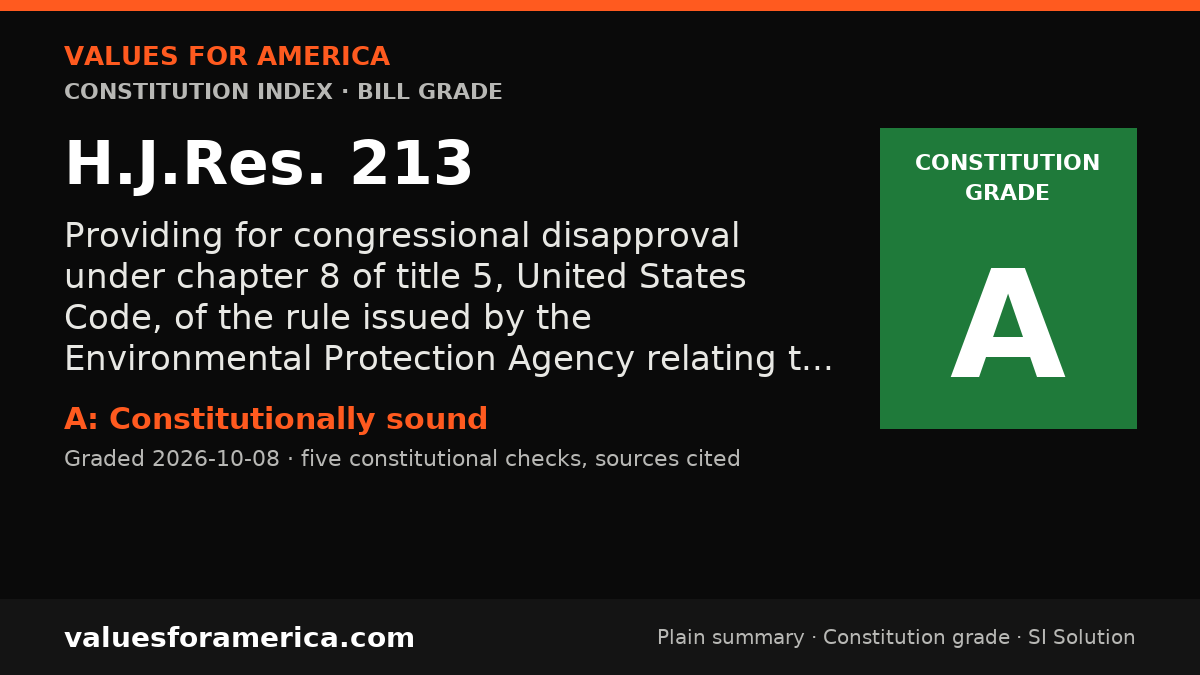
Providing for congressional disapproval under chapter 8 of title 5, United States Code, of the rule issued by the Environmental Protection Agency relating to the "California State Nonroad Engine Pollution Control Standards; Commercial Harbor Craft Regulations; Notice of Decision".
Cosponsors: 5 (0 D, 5 R) · per Congress.gov, 2026-10-15
Introduced: 2026-08-10
Latest action (2026-09-17): Received in the Senate.
What H.J.Res. 213 does, in plain terms
This joint resolution revokes the partial authorization granted to the California Air Resources Board (CARB) to amend its Commercial Harbor Craft regulation. Among other elements, the amendments proposed by CARB and partially authorized by the Environmental Protection Agency (EPA) create new emission standards and compliance dates depending on vessel category and engine model year and expand the types of vessels covered by the regulation (e.g. commercial fishing boats). (Under the Clean Air Act, the EPA may authorize California to adopt and enforce standards relating to the control of emissions from nonroad vehicles or engines if those standards meet certain requirements.) Specifically, the joint resolution nullifies the EPA authorization decision titled California State Nonroad Engine Pollution Control Standards; Commercial Harbor Craft Regulations; Notice of Decision.
Official summary by the Congressional Research Service, via Congress.gov.
Constitution Index
“VFA Constitution grade”
Constitutionally sound
Graded 2026-10-08
SI-generated grade · five published checks · not individually reviewed by a person · methodology
HJRES 213 is a constitutional use of congressional oversight to nullify an EPA authorization for added California harbor-craft emission rules. It stays within enumerated legislative power, infringes no rights, reduces burdens on individuals, returns decision-making toward the states, and involves no taking or due-process denial.
-
✓ Passes · Enumerated powers
Congress acts within explicit authority. Article I, Section 1 vests legislative power in Congress. Article I, Section 8, Clause 3 supports regulation of interstate commerce affected by harbor craft, and Article I, Section 8, Clause 18 supports laws necessary and proper for overseeing executive agencies. Review and disapproval of agency rules under chapter 8 of title 5 is a legislative check on del… -
✓ Passes · Bill of Rights
HJRES 213 does not restrict speech, religion, press, assembly, arms, privacy against search, or other protections in the first ten Amendments. It removes a federal authorization for added emission rules, thereby reducing regulatory burden rather than imposing a rights restriction. No provision of the First through Tenth Amendments is infringed. -
✓ Passes · Individual sovereignty
The bill imposes no new mandate on persons, vessels, labor, belief, or speech. It revokes partial EPA authorization for CARB commercial harbor craft amendments, including expanded vessel coverage and compliance dates. The burden on owners and operators of commercial fishing boats and other craft is therefore reduced, leaving greater control over property and labor with individuals under the Ninth … -
✓ Passes · Decentralization
This resolution moves authority downward. (1) Individuals cannot set vessel emission standards alone, so individual handling is false. (2) Local ports alone cannot manage interstate harbor and vessel pollution, so local handling is false. (3) States can set nonroad standards under the Clean Air Act waiver process, so state handling is true. (4) It does not consolidate upward; it nullifies a federa… -
✓ Passes · Due process and takings
The resolution does not seize property, impose fines, create criminal liability, or bypass notice and hearing. Under the Fifth Amendment Due Process and Takings Clauses, no property is taken and no proceeding is short-circuited. It uses the public legislative process under Article I, Section 1 and chapter 8 of title 5, preserving procedural regularity.
Sources: Congress.gov: HJRES 213 summary
Report an error in this grade
What should pass
“VFA SI Solution”
No solution yet
A sourced SI draft appears here once it passes automated checks (Constitution citation, source verification, independent SI critic). How publication works.
Related on VFA

For journalists and bloggers
“Embed this grade”
Free to use with the link back. The badge and card update when the grade changes. Embed terms →
