H.J.Res. 210 explained · 119th Congress · Pending in Congress
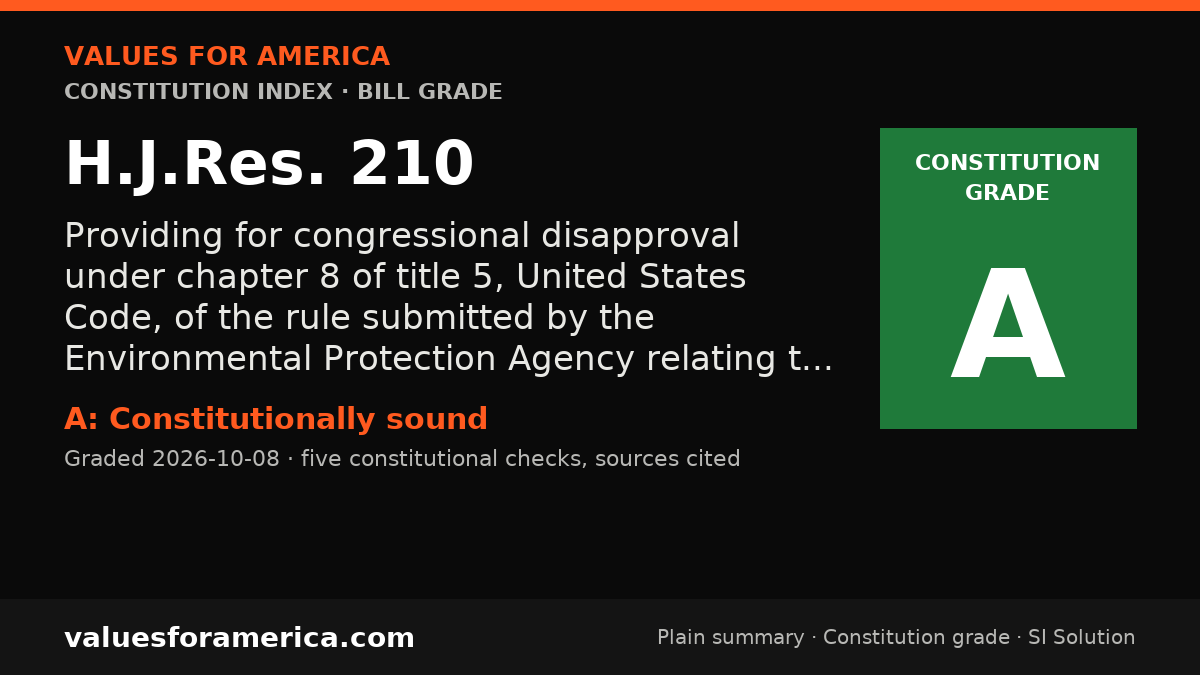
Providing for congressional disapproval under chapter 8 of title 5, United States Code, of the rule submitted by the Environmental Protection Agency relating to "California State Nonroad Engine Pollution Control Standards; Ocean-Going Vessels At-Berth; Notice of Decision".
Cosponsors: 7 (0 D, 7 R) · per Congress.gov, 2026-10-14
Introduced: 2026-08-06
Latest action (2026-09-16): Received in the Senate.
What H.J.Res. 210 does, in plain terms
This joint resolution revokes the authorization granted to the California Air Resources Board (CARB) to amend its Ocean-Going Vessels At-Berth Regulation. Among other elements, the amendment proposed by CARB and authorized by the Environmental Protection Agency (EPA) expanded auxiliary engine emissions reductions requirements to include additional categories of ocean-going vessels. (Under the Clean Air Act, the EPA may authorize California to adopt and enforce standards relating to the control of emissions from nonroad vehicles or engines if those standards meet certain requirements.) Specifically, the joint resolution nullifies the EPA authorization decision titled California State Nonroad Engine Pollution Control Standards; Ocean-Going Vessels At-Berth; Notice of Decision.
Official summary by the Congressional Research Service, via Congress.gov.
Constitution Index
“VFA Constitution grade”
Constitutionally sound
Graded 2026-10-08
SI-generated grade · five published checks · not individually reviewed by a person · methodology
HJRES 210 is a constitutional exercise of congressional oversight under the Commerce Clause and the legislative process. Using SI-reviewed legislative history, it disapproves an EPA authorization without infringing the Bill of Rights, expanding individual burdens, bypassing due process, or consolidating power beyond the minimum necessary for uniform regulation of interstate and foreign vessel traffic.
-
✓ Passes · Enumerated powers
Congress has explicit authority to enact this disapproval. Article I, Section 1 vests legislative power in Congress; Article I, Section 7 prescribes the presentment process used by a joint resolution; Article I, Section 8, Clause 3 grants power to regulate commerce with foreign nations and among the several states, which directly covers ocean-going vessels in interstate and foreign commerce; and A… -
✓ Passes · Bill of Rights
The resolution imposes no restriction on speech, religion, assembly, press, arms, quartering, searches, self-incrimination, trial rights, jury, punishment, or unenumerated rights. First Amendment, Second Amendment, Fourth Amendment, Fifth Amendment, Sixth Amendment, Eighth Amendment and Ninth Amendment are not implicated. It removes a regulatory authorization rather than compelling speech, search,… -
✓ Passes · Individual sovereignty
The resolution restricts no person, property use, speech, labor, or belief. It nullifies an EPA authorization that would have permitted expanded auxiliary-engine emissions controls on additional vessel categories at-berth, thereby reducing prospective compliance burdens on vessel operators, ports, and related labor. The burden justification runs in favor of liberty here: Congress withdraws rather … -
✓ Passes · Decentralization
Ocean-going vessel emissions involve foreign and interstate commerce calling at multiple ports and cannot be managed by individuals, families, or counties without fragmenting control of mobile sources. A single-state add-on standard for vessels in interstate and foreign commerce burdens interstate movement and undermines the uniform federal baseline under Article I, Section 8, Clause 3. Nullifying… -
✓ Passes · Due process and takings
The resolution effects no deprivation of life, liberty, or property under the Fifth Amendment Due Process Clause and effects no taking under the Fifth Amendment Takings Clause. It provides no adjudication against any person, imposes no penalty, search, or seizure, and requires no notice-and-hearing beyond the legislative process itself under Article I, Section 1 and Article I, Section 7. By voidin…
Sources: Congress.gov: HJRES 210 summary
Report an error in this grade
What should pass
“VFA SI Solution”
SI-generated · passed automated checks (Constitution citation, source verification, independent SI critic) · not individually reviewed by a person · Report an error: hello@valuesforamerica.com
Port Clean Air Pilot and Federal Review Act
Generated by VFA SI Solutions
Reduce air pollution from ocean-going vessels while docked by expanding emissions controls to more vessel types. The mechanism in the source is congressional disapproval of federal authorization for California to enforce that expansion.
Bipartisan rationale: Republicans and conservatives gain protection against a single state setting de facto national shipping rules, plus a capped budget, no new tax, and a five-year sunset. Democrats and progressives gain continued action on dockside air pollution, grant funding for shore power and monitoring, and yearly public data to support future standards if the evidence warrants them.
Possible legislative path: House support may come from coastal district members concerned about port air and from commerce-minded members seeking cost data, while opposition may come from members favoring immediate mandates or opposing any port spending; Senate dynamics may follow a similar split between health and trade interests.
Source limits: The full bill text, current Clean Air Act requirements, eligibility rules for California authorizations, existing appeal rights, fiscal effects, and likely votes are not stated in the official summary and should be verified at Congress.gov before action.
Article I, Section 8, Clause 3 Article I, Section 8, Clause 1 Amendment X Amendment V
Report an error in this Solution
Citizen Consensus
“Do you support this VFA SI Solution?”
One vote per verified account; you can change it any time. Only verified accounts count, results publish once 30 verified people have voted, and state and district results count only people who attested a home ZIP code. How this works.
Email verification is not switched on yet, so no vote counts toward results yet. Votes cast now are saved and count once the voter verifies their email address.
Sign in or create a free account to vote.
Add a short reason (optional)
/280 · no links or contact details · reasons are reviewed before anyone sees them, and many never are shown.
Your vote is saved but held out of published results by an automated integrity check (for example, several accounts voting from one browser).
Your vote is saved. It will count once you verify your email address. Verify on your account page.
Your vote counts nationally. Add your home ZIP code to count in your state and district too.
Your vote counts nationally and in .
Reason saved privately; it is shown only if it passes review.
Verified participants nationwide · n =
Self-selected participants, not a random sample; ± is the 95% sampling margin.
Not enough verified votes yet. Results publish at verified votes.
A sudden surge of votes on this item was flagged and is under review; votes from new accounts in that surge are held out until it is resolved.
Related on VFA

For journalists and bloggers
“Embed this grade”
Free to use with the link back. The badge and card update when the grade changes. Embed terms →
