H.J.Res. 20 explained · 119th Congress · Became law
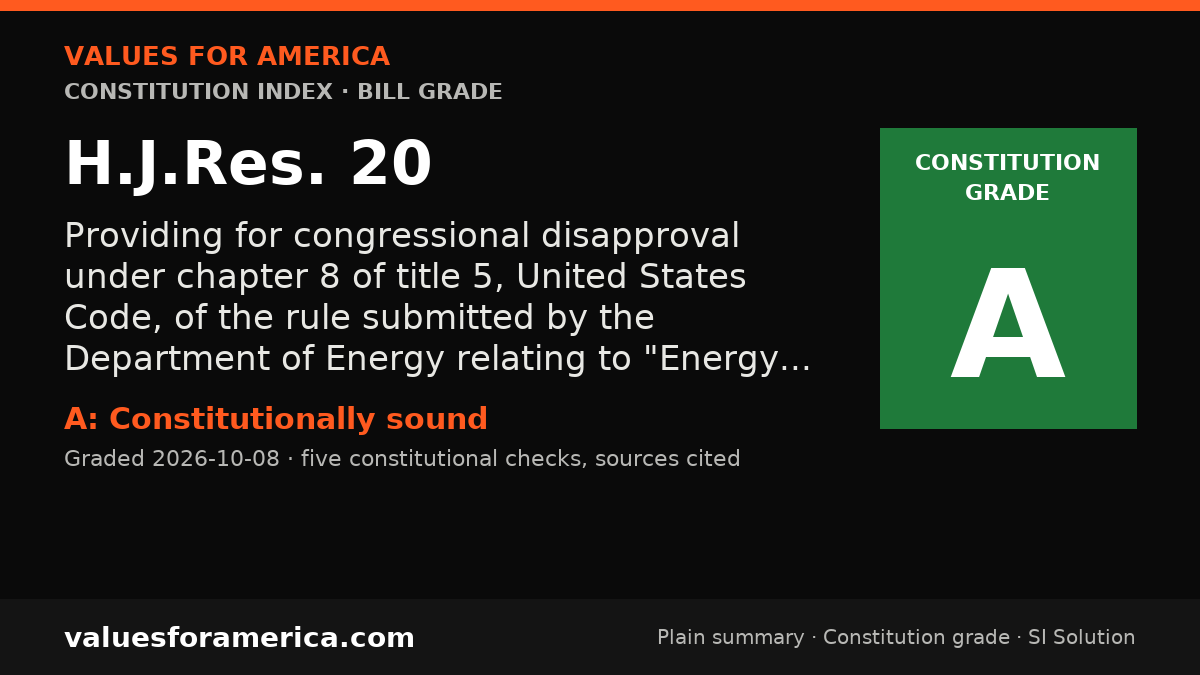
Providing for congressional disapproval under chapter 8 of title 5, United States Code, of the rule submitted by the Department of Energy relating to "Energy Conservation Program: Energy Conservation Standards for Consumer Gas-fired Instantaneous Water Heaters".
Cosponsors: 29 (0 D, 29 R) · per Congress.gov, 2026-10-11
Introduced: 2025-01-15
Latest action (2025-05-09): Became Public Law No: 119-6.
What H.J.Res. 20 does, in plain terms
This joint resolution nullifies the rule titled Energy Conservation Program: Energy Conservation Standards for Consumer Gas-fired Instantaneous Water Heaters and submitted by the Department of Energy (DOE) on December 26, 2024. Under the rule, DOE adopted amended energy conservation standards for gas-fired instantaneous water heaters to achieve the maximum improvement in energy efficiency that DOE determined was technologically feasible and economically justified.
Official summary by the Congressional Research Service, via Congress.gov.
Constitution Index
“VFA Constitution grade”
Constitutionally sound
Graded 2026-10-08
SI-generated grade · five published checks · not individually reviewed by a person · methodology
HJRES 20 repeals a Department of Energy efficiency mandate on consumer gas water heaters through congressional disapproval, restoring purchasing choice. It exercises legitimate congressional oversight, infringes no rights, expands individual sovereignty over property, and decentralizes power away from the federal level. Fully constitutional.
-
✓ Passes · Enumerated powers
Congress acts within explicit authority: Article I, Section 8, Clause 18 (Necessary and Proper Clause) to execute its legislative power and oversee the executive, combined with Article I, Section 1 vesting legislative power in Congress and Article II, Section 3 oversight of faithful execution. Disapproving an executive agency rule under chapter 8 of title 5 corrects executive overreach rather than… -
✓ Passes · Bill of Rights
Nullification removes a federal restriction on consumer product choice and does not itself abridge speech, religion, press, arms, search protections, or other guarantees. It tends to protect Ninth Amendment retained rights and Tenth Amendment reserved powers by withdrawing a federal mandate on household appliances rather than imposing one. -
✓ Passes · Individual sovereignty
The action expands individual sovereignty by removing federal limits on what models of gas-fired instantaneous water heaters a person may buy, own, and use on their own property. No personal conduct, speech, labor, or belief is restricted; the burden the prior rule placed on consumers is lifted without substitute restriction. -
✓ Passes · Decentralization
Water-heater selection can be handled by individuals and families through market choice, and any residual efficiency or building-code concerns can be handled locally or at the state level. This joint resolution moves decision-making downward by removing a federal mandate, so it does not consolidate upward and satisfies the Tenth Amendment subsidiarity principle. -
✓ Passes · Due process and takings
The resolution imposes no penalty, seizure, or property taking and requires no notice-and-hearing procedure because it grants relief from regulation. It restores ordinary Fifth Amendment liberty and property use by eliminating compliance costs and product restrictions imposed by the underlying rule.
Sources: Congress.gov: HJRES 20 summary
Report an error in this grade
What should pass
“VFA SI Solution”
No solution yet
A sourced SI draft appears here once it passes automated checks (Constitution citation, source verification, independent SI critic). How publication works.
Related on VFA

For journalists and bloggers
“Embed this grade”
Free to use with the link back. The badge and card update when the grade changes. Embed terms →
