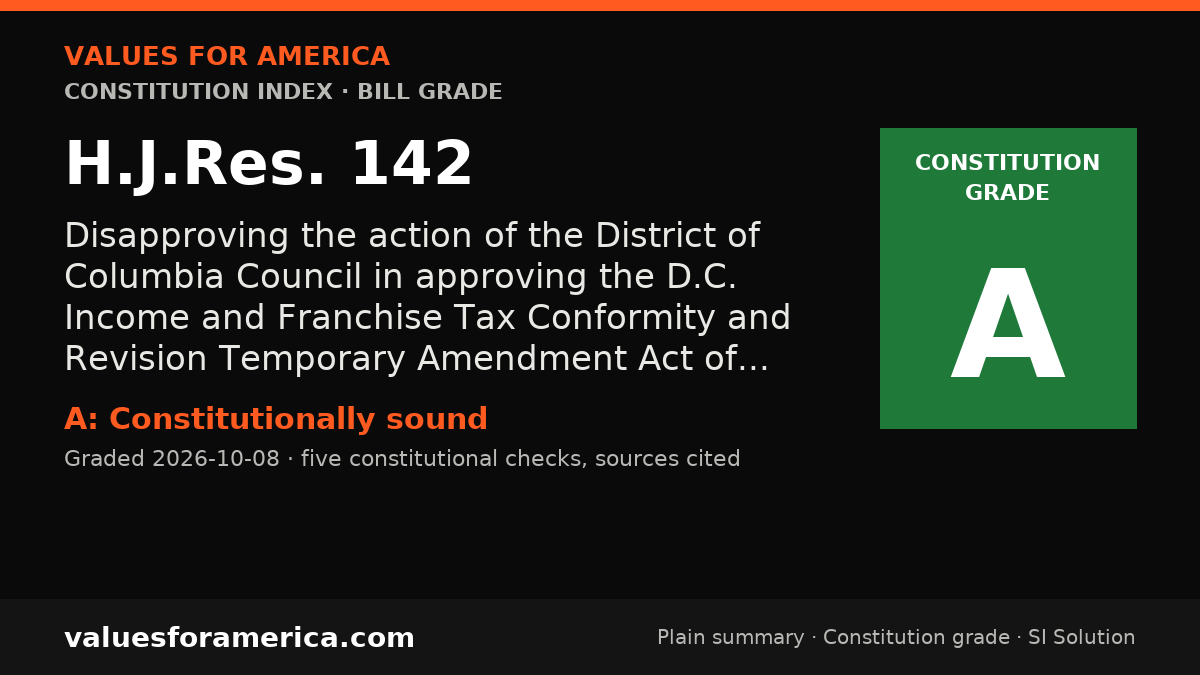
H.J.Res. 142 explained · 119th Congress · Became law
Disapproving the action of the District of Columbia Council in approving the D.C. Income and Franchise Tax Conformity and Revision Temporary Amendment Act of 2025.
Cosponsors: 1 (0 D, 1 R) · per Congress.gov, 2026-10-09
Introduced: 2026-01-22
Latest action (2026-02-18): Became Public Law No: 119-78.
What H.J.Res. 142 does, in plain terms
This joint resolution reinstates provisions of District of Columbia (DC) tax law to conform with federal tax law. As background, DC generally automatically adopts changes to federal tax law (known as rolling conformity). Therefore, upon enactment of the 2025 reconciliation act (commonly known as the One Big Beautiful Bill Act), many of its tax provisions became DC law. DC subsequently enacted its own legislation (the DC Income and Franchise Tax Conformity and Revision Temporary Amendment Act of 2025) that decoupled DC tax law from these federal provisions. This joint resolution nullifies the DC legislation, thereby generally realigning DC tax law with the tax provisions of the 2025 reconciliation act. Specifically, the joint resolution reinstates for DC provisions that • increase the higher basic standard deduction; • increase deductible charitable cash contributions (for taxpayers who take the standard deduction); • establish a $6,000 tax deduction for taxpayers 65 years and older; • allow a tax deduction of qualified tips, qualified overtime pay, and qualified car loan interest; • authorize an elective 100% depreciation allowance for nonresidential real property; and • authorize businesses to deduct 100% of research and experimental costs retroactive to tax year 2022. The DC legislation also amended several other provisions of DC tax law, including restoring the DC child tax credit. The joint resolution negates these changes.
Official summary by the Congressional Research Service, via Congress.gov.
Constitution Index
“VFA Constitution grade”
Constitutionally sound
Graded 2026-10-08
SI-generated grade · five published checks · not individually reviewed by a person · methodology
Congress acted within its explicit District power to review District tax law, with no Bill of Rights, sovereignty, or due process violation. Local control tension exists but is resolved by the Constitution itself.
-
✓ Passes · Enumerated powers
Congress has explicit authority over the District under Article I, Section 8, Clause 17, which grants exclusive legislation over the seat of government. The District of Columbia Home Rule Act preserves congressional review and disapproval of Council acts. This joint resolution enacted under Article I, Section 7 disapproves a Council tax act, which is within that enumerated federal-district power, … -
✓ Passes · Bill of Rights
No speech, religion, press, assembly, arms, search, trial, or punishment provision is implicated. The resolution adjusts District of Columbia tax conformity rules and deductions. It does not compel speech under the First Amendment, disarm under the Second Amendment, authorize searches under the Fourth Amendment, or impose punishment under the Eighth Amendment. Tax classification is permitted under… -
✓ Passes · Individual sovereignty
The resolution does not restrict person, speech, labor, belief, or property use beyond ordinary tax law. It largely reinstates deductions for standard filers, older taxpayers, tips, overtime, car loan interest, charitable gifts, and business expensing, reducing tax burden. Removal of the District child credit change alters a benefit level but taxation with representation through Article I does not… -
✓ Passes · Decentralization
Tax conformity for the federal District cannot be handled by an individual or family, and no state has jurisdiction over District tax law. The local Council can and did handle it, but Article I, Section 8, Clause 17 expressly grants Congress exclusive legislation over the District. Congressional review therefore is the constitutionally prescribed minimum level for this action, not improper upward … -
✓ Passes · Due process and takings
No person is deprived of life, liberty, or property without due process under the Fifth Amendment. The change was enacted through bicameralism and presentment under Article I, Section 7, with prospective tax rules and public law status. No physical or regulatory taking occurs and no compensation is owed under the Fifth Amendment Takings Clause. Ordinary taxation with notice and legislative process…
Sources: Congress.gov: HJRES 142 summary
Report an error in this grade
What should pass
“VFA SI Solution”
No solution yet
A sourced SI draft appears here once it passes automated checks (Constitution citation, source verification, independent SI critic). How publication works.
Related on VFA

For journalists and bloggers
“Embed this grade”
Free to use with the link back. The badge and card update when the grade changes. Embed terms →
