H.J.Res. 139 explained · 119th Congress · Pending in Congress
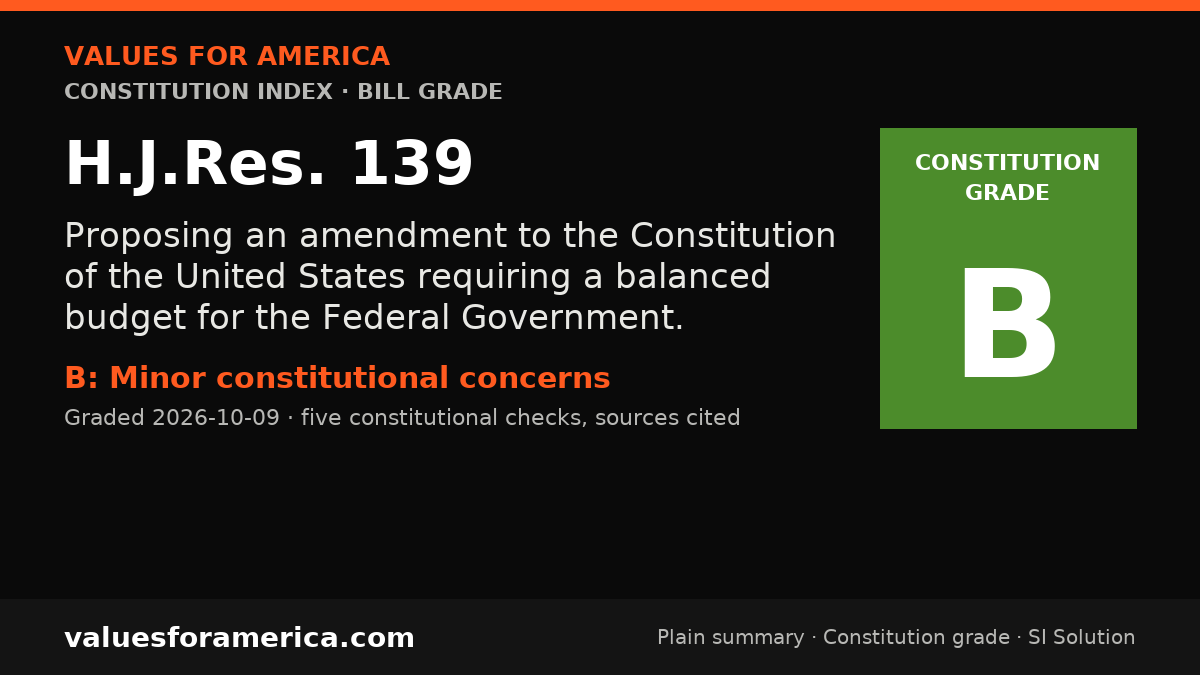
Proposing an amendment to the Constitution of the United States requiring a balanced budget for the Federal Government.
Cosponsors: 2 (0 D, 2 R) · per Congress.gov, 2026-10-09
Introduced: 2026-01-09
Latest action (2026-03-18): On motion to suspend the rules and pass the resolution Failed by the Yeas and Nays: (2/3 required): 211 - 207 (Roll no. 95).
What H.J.Res. 139 does, in plain terms
This joint resolution proposes a constitutional amendment prohibiting total federal expenditures for a year from exceeding the average annual federal receipts collected in the three prior years, adjusted for changes in the population of U.S. citizens and inflation. Expenditures for payment of debt and receipts derived from borrowing are excluded. Under the amendment, Congress may authorize specific expenditures in excess of the limit with (1) a roll call vote of two-thirds of each chamber, or (2) a roll call vote for any year in which a declaration of war is in effect. The amendment also prohibits any bill to levy a new tax or increase the rate of any tax from becoming law unless it has been approved by a roll call vote of two-thirds of the whole number of each chamber of Congress. The requirements take effect in the fifth year beginning after ratification of the amendment.
Official summary by the Congressional Research Service, via Congress.gov.
Constitution Index
“VFA Constitution grade”
Minor constitutional concerns
Graded 2026-10-09
SI-generated grade · five published checks · not individually reviewed by a person · methodology
This proposed constitutional amendment imposes a balanced budget requirement and supermajority rules for tax increases on the federal government. It does not infringe any enumerated rights or individual sovereignty, and it respects due process. However, it centralizes fiscal rule-making at the federal level in a way that cannot be handled by individuals, localities, or states, creating minor tension with the principle of decentralization. Overall, the amendment is mostly sound with a fixable structural concern.
-
✓ Passes · Enumerated powers
The amendment constrains Congress's existing taxing and spending powers under Article I, Section 8. It does not grant new federal authority or exceed enumerated powers; rather, it imposes procedural limits on their exercise. The amendment is proposed under Article V, which is the proper mechanism for altering constitutional structure. -
✓ Passes · Bill of Rights
The amendment does not restrict speech, religion, press, assembly, petition, arms, quartering, search and seizure, self-incrimination, due process, fair trial, jury, cruel and unusual punishment, unenumerated rights, or reserved powers. It only imposes procedural requirements on federal fiscal legislation, which does not directly implicate any provision of the first ten amendments. -
✓ Passes · Individual sovereignty
The amendment restricts government action (taxing and spending) but does not directly limit what individuals may do with their person, property, speech, labor, or belief. Any indirect effect on taxation levels does not constitute a restriction on individual sovereignty without compelling justification, as the government bears no burden to justify a constraint that does not exist. -
✗ Concern · Decentralization
The amendment imposes a federal constitutional rule on federal budgeting. (1) An individual or family cannot handle federal fiscal policy without government involvement. (2) A local community or county cannot handle it without state involvement. (3) A state cannot handle it without federal involvement because the amendment governs the federal government itself. (4) The action consolidates decision… -
✓ Passes · Due process and takings
The amendment does not bypass procedural or substantive due process, nor does it take private property without just compensation. It establishes legislative procedures for Congress and does not affect individual rights to fair notice, hearing, or property. No Fifth Amendment violation is present.
Sources: Congress.gov: HJRES 139 summary
Report an error in this grade
What should pass
“VFA SI Solution”
No solution yet
A sourced SI draft appears here once it passes automated checks (Constitution citation, source verification, independent SI critic). How publication works.
Related on VFA

For journalists and bloggers
“Embed this grade”
Free to use with the link back. The badge and card update when the grade changes. Embed terms →
