H.J.Res. 1 explained · 119th Congress · Pending in Congress
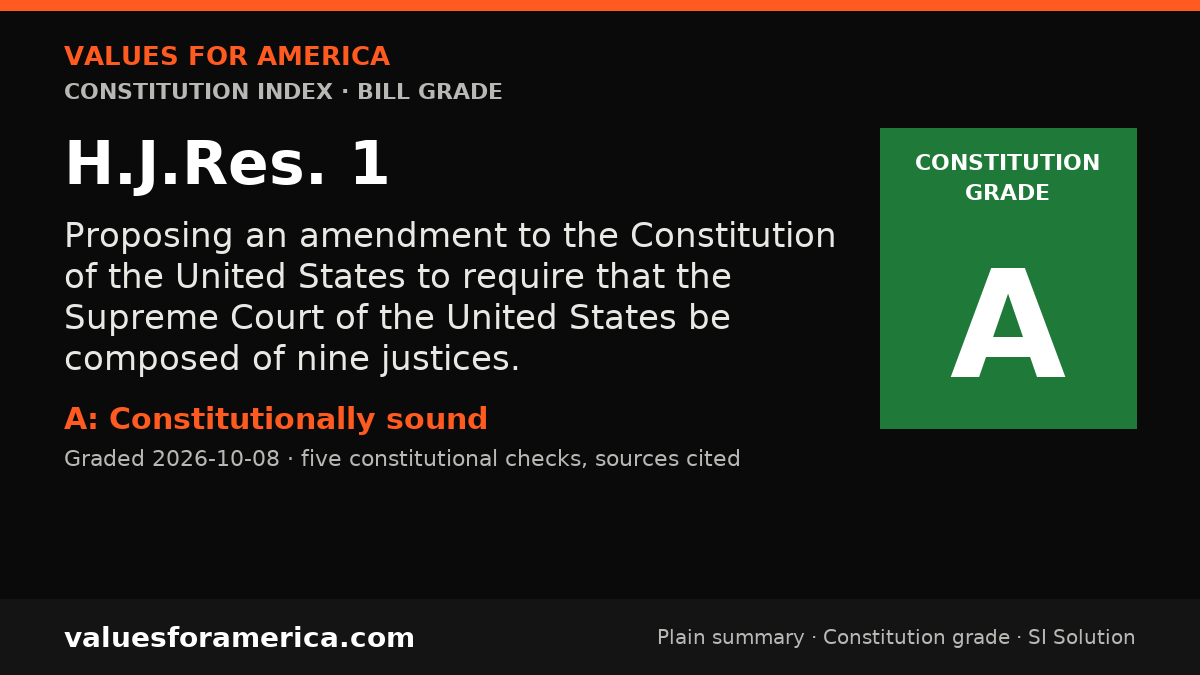
Proposing an amendment to the Constitution of the United States to require that the Supreme Court of the United States be composed of nine justices.
Cosponsors: 2 (0 D, 2 R) · per Congress.gov, 2026-10-15
Introduced: 2025-01-03
Latest action (2026-09-02): On motion to suspend the rules and pass Failed by the Yeas and Nays: (2/3 required): 212 - 206 (Roll no. 293).
What H.J.Res. 1 does, in plain terms
This joint resolution proposes a constitutional amendment requiring the Supreme Court to be composed of nine Justices—one Chief Justice and eight Associate Justices.
Official summary by the Congressional Research Service, via Congress.gov.
Constitution Index
“VFA Constitution grade”
Constitutionally sound
Graded 2026-10-08
SI-generated grade · five published checks · not individually reviewed by a person · methodology
HJRES 1 uses the constitutionally prescribed Article V amendment process to fix Supreme Court membership at one Chief Justice and eight Associate Justices. It asserts no unauthorized federal power, infringes no right, restricts no individual liberty, transfers no decision upward, and denies no process or property. Failed House passage on 2026-09-02 does not affect its constitutional soundness.
-
✓ Passes · Enumerated powers
Congress has explicit authority to propose constitutional amendments under Article V, requiring two-thirds of both Houses followed by ratification. This joint resolution uses only that lawful channel and claims no new regulatory power under Article I, Section 8. Structuring the Supreme Court is expressly contemplated by Article III, Section 1, which vests the judicial power in one supreme Court an… -
✓ Passes · Bill of Rights
Fixing the Court at nine Justices restricts no protected right. It does not limit speech, religion, press, assembly or petition under the First Amendment, does not disarm anyone under the Second Amendment, authorizes no search or seizure under the Fourth Amendment, compels no testimony under the Fifth Amendment, and imposes no punishment under the Eighth Amendment. It preserves the judicial struct… -
✓ Passes · Individual sovereignty
The resolution restricts no personal conduct involving body, property, speech, labor, or belief. It governs only the size of a federal institution under Article III, Section 1. Because there is no restriction on individual liberty, the government bears no additional justification burden beyond its lawful Article V amendment power. -
✓ Passes · Decentralization
Composition of the Supreme Court of the United States is inherently a national function under Article III, Section 1. No individual, county, or state can constitute the federal Supreme Court. The proposal does not move any new power upward; it locks the existing nine-member structure in place and leaves all powers reserved to the States by the Tenth Amendment untouched. -
✓ Passes · Due process and takings
The measure orders no arrest, prosecution, seizure, hearing denial, or transfer of property. It therefore triggers no procedural due process, substantive due process, presumption-of-innocence, or just-compensation issue under the Fifth Amendment and Fourteenth Amendment, Section 1. No property is taken and no adjudication is bypassed.
Sources: Congress.gov: HJRES 1 summary
Report an error in this grade
What should pass
“VFA SI Solution”
No solution yet
A sourced SI draft appears here once it passes automated checks (Constitution citation, source verification, independent SI critic). How publication works.
Related on VFA

For journalists and bloggers
“Embed this grade”
Free to use with the link back. The badge and card update when the grade changes. Embed terms →
