H.Con.Res. 64 explained · 119th Congress · Pending in Congress
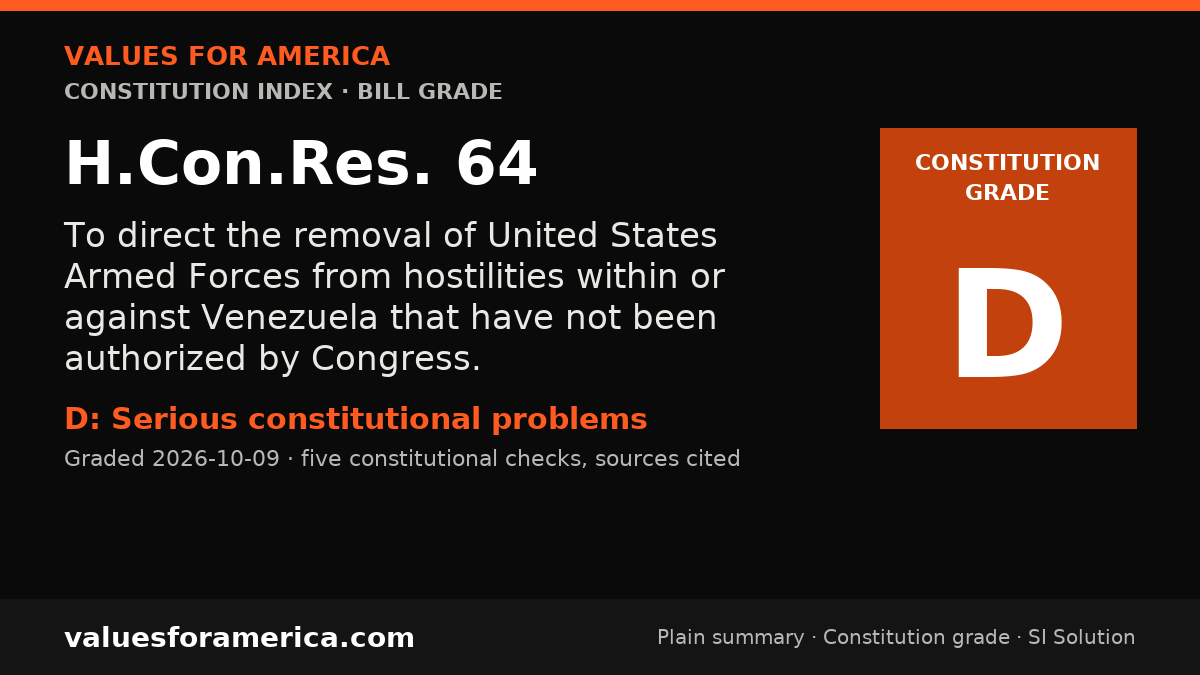
To direct the removal of United States Armed Forces from hostilities within or against Venezuela that have not been authorized by Congress.
Cosponsors: 46 (43 D, 3 R) · per Congress.gov, 2026-10-09
Introduced: 2025-12-01
Latest action (2025-12-17): Motion to reconsider laid on the table Agreed to without objection.
What H.Con.Res. 64 does, in plain terms
This concurrent resolution directs the President to remove U.S. Armed Forces from hostilities within or against Venezuela unless a declaration of war or authorization to use military force for such purpose has been enacted.
Official summary by the Congressional Research Service, via Congress.gov.
Constitution Index
“VFA Constitution grade”
Serious constitutional problems
Graded 2026-10-09
SI-generated grade · five published checks · not individually reviewed by a person · methodology
The purpose of this concurrent resolution is to vindicate Congress's constitutional authority over whether U.S. Armed Forces remain in unauthorized hostilities, which is a legitimate and important constitutional function. However, the measure attempts to bind the President through a concurrent resolution, which is not presented to the President for signature or veto. Under Article I, Section 7, Clause 2, a binding directive to the Executive must take the form of a bill or joint resolution passed by both houses and presented to the President. A concurrent resolution that directs removal is therefore a legislative veto and is likely unconstitutional. To achieve its goal constitutionally, it must be rewritten as a joint resolution or as an appropriations condition or other law.
-
✗ Concern · Enumerated powers
Congress has explicit authority over the armed forces and the power to declare war under Article I, Section 8, Clauses 11–14. The underlying goal—ensuring military hostilities have congressional authorization—is within Congress's enumerated powers. But a concurrent resolution is not a law and has no presentment to the President under Article I, Section 7, Clause 2. A binding directive in the form … -
✓ Passes · Bill of Rights
This resolution does not implicate any provision of the First through Tenth Amendments. It does not restrict speech, religion, press, assembly, petition, arms, quartering, search and seizure, criminal procedure, or punishment. It concerns the deployment and removal of military forces, not individual civil liberties. -
✓ Passes · Individual sovereignty
The resolution does not restrict what individuals may do with their own person, property, speech, labor, or belief. It does not impose conscription, seize property, or criminalize conduct. To the contrary, it seeks to limit unauthorized military action, which generally protects individual sovereignty rather than infringing it. -
✓ Passes · Decentralization
Foreign military hostilities are inherently a federal matter under Article I, Section 8 and Article II, Section 2. An individual, family, local community, or state cannot conduct national military policy against Venezuela. The federal government is the appropriate level, and the resolution does not consolidate power upward beyond what the Constitution already contemplates for war and foreign affai… -
✓ Passes · Due process and takings
No person is deprived of life, liberty, or property by this resolution. It does not deny procedural due process, create presumptions of guilt, or take property without just compensation. The constitutional defect is the legislative form, not a deprivation of individual rights.
Sources: Congress.gov: HCONRES 64 summary
Report an error in this grade
What should pass
“VFA SI Solution”
No solution yet
A sourced SI draft appears here once it passes automated checks (Constitution citation, source verification, independent SI critic). How publication works.
Related on VFA

For journalists and bloggers
“Embed this grade”
Free to use with the link back. The badge and card update when the grade changes. Embed terms →
