H.Con.Res. 30 explained · 119th Congress · Pending in Congress
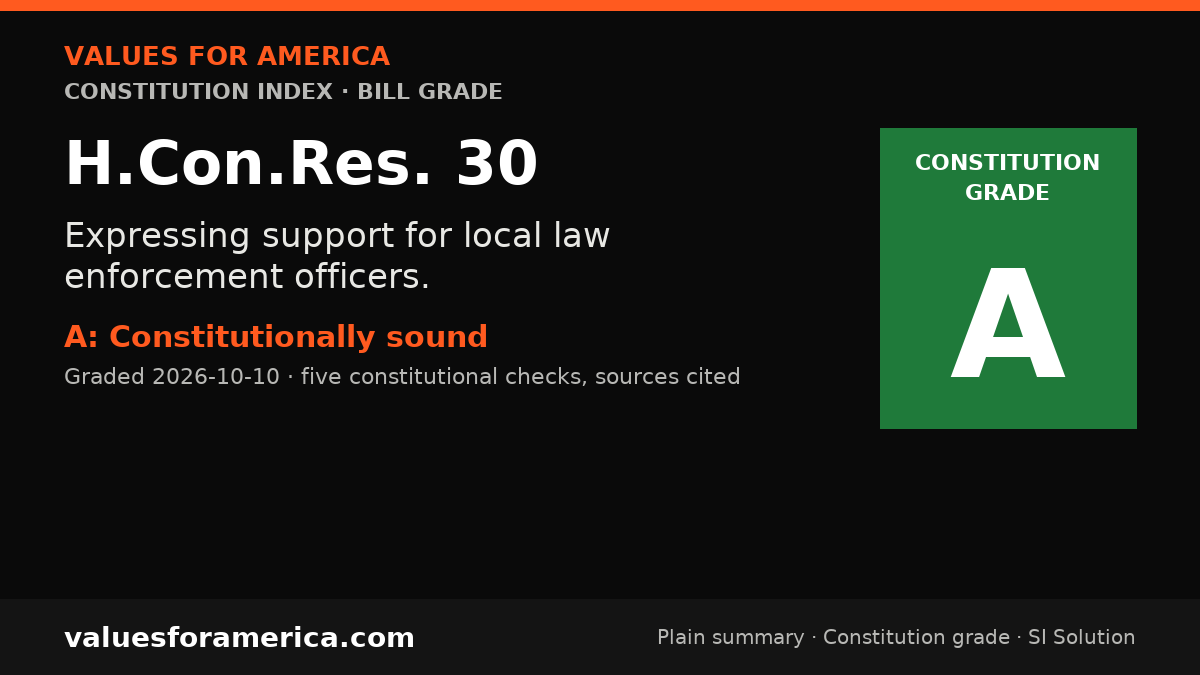
Expressing support for local law enforcement officers.
Cosponsors: 35 (3 D, 32 R) · per Congress.gov, 2026-10-11
Introduced: 2025-05-06
Latest action (2025-05-20): Star Print ordered on the referred concurrent resolution.
What H.Con.Res. 30 does, in plain terms
This concurrent resolution recognizes and appreciates local law enforcement officers, extends gratitude to local law enforcement officers and their families, honors local law enforcement officers who have fallen in the line of duty, and encourages continued collaboration between local law enforcement agencies and the communities they serve.
Official summary by the Congressional Research Service, via Congress.gov.
Constitution Index
“VFA Constitution grade”
Constitutionally sound
Graded 2026-10-10
SI-generated grade · five published checks · not individually reviewed by a person · methodology
This concurrent resolution is purely expressive and symbolic. It does not authorize any federal action, spending, or regulation. It merely states support for local law enforcement, thanks officers and families, honors fallen officers, and encourages community collaboration. Because it imposes no legal obligation, restricts no rights, and does not expand federal power, it is fully constitutional.
-
✓ Passes · Enumerated powers
The resolution is a non-binding expression of sentiment by Congress. It does not exercise any enumerated power under Article I, Section 8, nor does it attempt to regulate, fund, or command any action. Such resolutions are a traditional form of congressional speech and do not require specific enumerated authority. -
✓ Passes · Bill of Rights
The resolution does not restrict speech, religion, press, assembly, petition, arms, quartering, search and seizure, self-incrimination, due process, takings, trial rights, or cruel and unusual punishment. It has no effect on any right protected by the first ten amendments. -
✓ Passes · Individual sovereignty
The resolution imposes no restriction on any person's person, property, speech, labor, or belief. It is purely hortatory and does not command, forbid, or penalize any individual conduct. -
✓ Passes · Decentralization
The resolution does not consolidate any decision-making authority. It merely expresses support for local law enforcement, which is inherently a local function. No individual, family, community, or state is displaced or overridden. -
✓ Passes · Due process and takings
The resolution does not deprive any person of life, liberty, or property, nor does it take any property without just compensation. It creates no legal process or obligation.
Sources: Congress.gov: HCONRES 30 summary
Report an error in this grade
What should pass
“VFA SI Solution”
No solution yet
A sourced SI draft appears here once it passes automated checks (Constitution citation, source verification, independent SI critic). How publication works.
Related on VFA

For journalists and bloggers
“Embed this grade”
Free to use with the link back. The badge and card update when the grade changes. Embed terms →
