H.Con.Res. 14 explained · 119th Congress · Pending in Congress
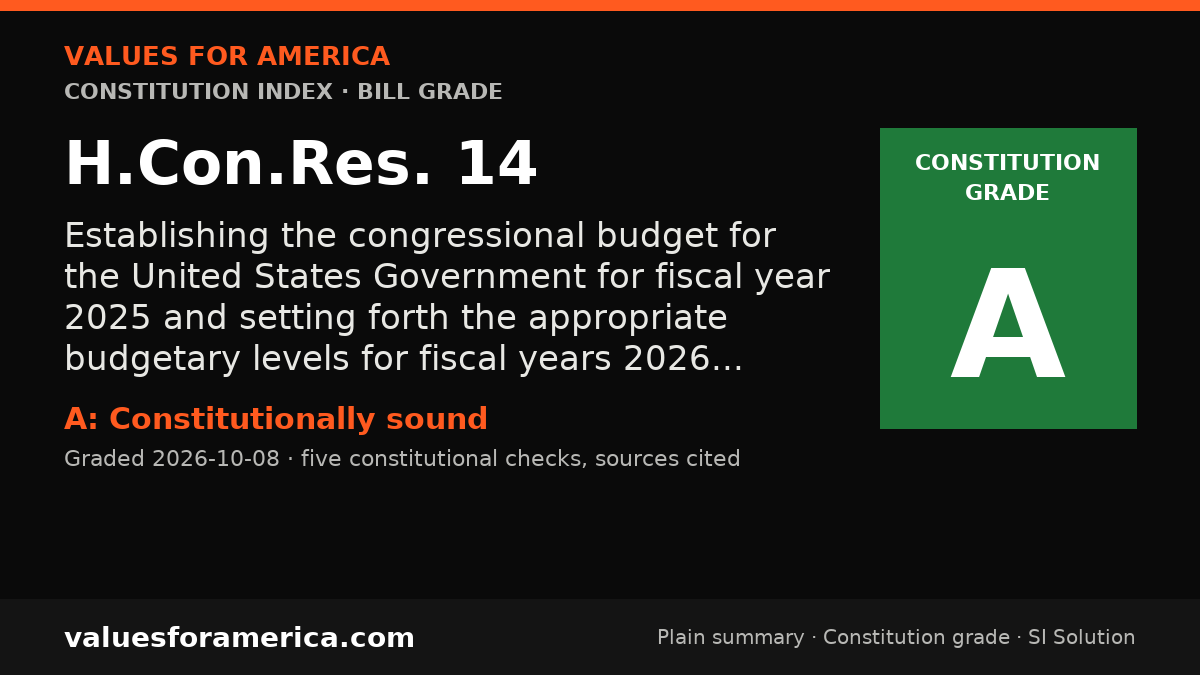
Establishing the congressional budget for the United States Government for fiscal year 2025 and setting forth the appropriate budgetary levels for fiscal years 2026 through 2034.
Cosponsors: none · per Congress.gov, 2026-10-11
Introduced: 2025-02-18
Latest action (2025-05-20): Star Print ordered on the reported concurrent resolution.
What H.Con.Res. 14 does, in plain terms
This concurrent resolution establishes the congressional budget for the federal government for FY2025, sets forth budgetary levels for FY2026-FY2034, and provides reconciliation instructions for legislation that increases or decreases the deficit and increases the statutory debt limit by specified amounts. The resolution recommends levels and amounts for FY2025-FY2034 for federal revenues, new budget authority, budget outlays, deficits, debt subject to limit, debt held by the public, and the major functional categories of spending. The resolution includes reconciliation instructions that direct 11 House committees to submit legislation that will increase or decrease the deficit over FY2025-FY2034 and increase the statutory debt limit by specified amounts. The committees must submit the legislation to the House Budget Committee by March 27, 2025. (Under current law, reconciliation bills are considered by Congress using expedited legislative procedures that prevent a filibuster and restrict amendments in the Senate.) In addition, the resolution establishes a reserve fund that allows certain adjustments to committee allocations and other budgetary levels to accommodate reconciliation legislation. The resolution also requires the maximum deficit increase permitted by the reconciliation instruction for the House Ways and Means Committee ($4.5 trillion in the resolution) to be reduced if the proposals submitted by certain committees do not achieve a total of at least $2 trillion in net deficit reduction (or increased if more than $2 trillion in deficit reduction is achieved). Finally, the resolution sets forth budget enforcement procedures that address issues such as adjustments to committee allocations and the budgetary treatment of the discretionary administrative expenses for the Social Security Administration and the U.S. Postal Service.
Official summary by the Congressional Research Service, via Congress.gov.
Constitution Index
“VFA Constitution grade”
Constitutionally sound
Graded 2026-10-08
SI-generated grade · five published checks · not individually reviewed by a person · methodology
HCONRES 14 is a routine exercise of Congress fiscal powers: setting federal budget levels and reconciliation instructions for FY2025-FY2034. It infringes no rights, takes no property, and governs only federal spending and revenue planning, which only Congress can perform.
-
✓ Passes · Enumerated powers
Congress has explicit authority for this action under Article I, Section 8, Clause 1 (power to lay and collect taxes and provide for common defence and general welfare), Article I, Section 8, Clause 2 (power to borrow money), and Article I, Section 9, Clause 7 (appropriations power). Setting budget levels and using reconciliation under the Congressional Budget Act is a core exercise of those enume… -
✓ Passes · Bill of Rights
Resolution sets aggregate revenue, spending, deficit and debt targets and reconciliation instructions. It creates no criminal penalty, speech restriction, search, seizure, taking, or trial procedure. No First through Tenth Amendment right is infringed. Tenth Amendment respected because budget planning is a federal function under Article I, Section 8, Clause 1 and Article I, Section 9, Clause 7. -
✓ Passes · Individual sovereignty
Resolution restricts no personal conduct, property use, speech, labor, or belief. It directs House committees to produce reconciliation legislation within deficit and debt parameters but imposes no mandate, prohibition, or tax on any individual. Government bears no additional justification burden here because no individual liberty is curtailed. -
✓ Passes · Decentralization
Federal budgeting cannot be handled by individuals, localities, or states acting alone; only Congress can set federal revenues, outlays, and debt limits. This action does not consolidate state or local decisions upward; it governs only the federal fiscal framework and reconciliation procedure, consistent with the Tenth Amendment reservation of other powers to states and people. -
✓ Passes · Due process and takings
No deprivation of life, liberty, or property and no taking occurs. As a concurrent budget resolution under Fifth Amendment due process and takings analysis, it provides notice through public legislative procedure, requires no hearing because it adjudicates no individual right, and authorizes no physical or regulatory taking of private property without just compensation.
Sources: Congress.gov: HCONRES 14 summary
Report an error in this grade
What should pass
“VFA SI Solution”
No solution yet
A sourced SI draft appears here once it passes automated checks (Constitution citation, source verification, independent SI critic). How publication works.
Related on VFA

For journalists and bloggers
“Embed this grade”
Free to use with the link back. The badge and card update when the grade changes. Embed terms →
