Archived SI output (machine-generated)
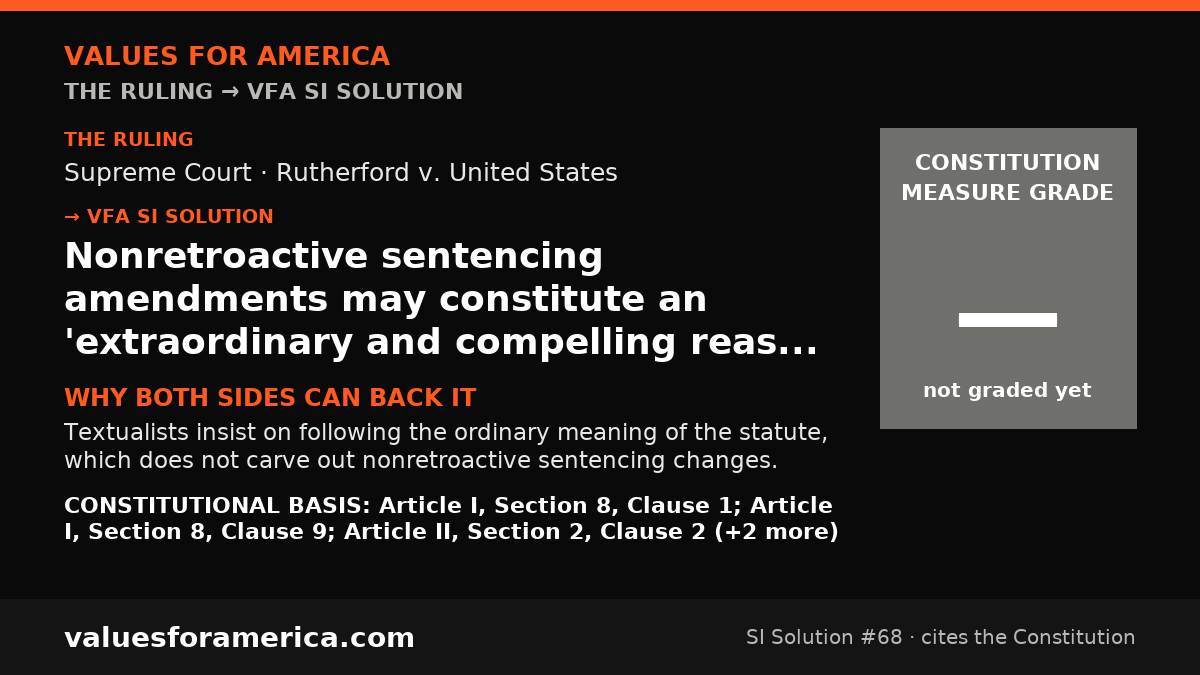
Nonretroactive sentencing amendments may constitute an 'extraordinary and compelling reason' under §3582(c)(1)(A)(i) when the resulting disparity is extreme, unjustified, and not based solely on congressional intent to deny relief.
Archived SI output (machine-generated) · No editorial review recorded
This historical SI draft was machine-generated by software and has no editorial review time on record. Verify its factual and legal claims against the original source before relying on it.
Rutherford v. United States
Amy Coney Barrett
Nonretroactive sentencing amendments may constitute an 'extraordinary and compelling reason' under §3582(c)(1)(A)(i) when the resulting disparity is extreme, unjustified, and not based solely on congressional intent to deny relief.
Whether a sentencing disparity created by a nonretroactive change to a criminal penalty can be an 'extraordinary and compelling reason' warranting compassionate release under 18 U.S.C. §3582(c)(1)(A)(i).
Constitutional concerns with the original
- The majority's reliance on congressional intent and 'will of Congress' as a textual limit on 'extraordinary and compelling' reasons, rather than deriving the meaning from the text itself. The statute does not say 'unless Congress deliberately declined retroactivity.'
- The treatment of the Sentencing Commission's 2023 policy statement as conflicting with 'the will of Congress' elevates implied congressional intent over the express delegation to the Commission in 28 U.S.C. §994(a) and (t) to define 'extraordinary and compelling reasons.'
- The reasoning creates a judicial exception—nonretroactive sentencing changes can never be extraordinary and compelling—that is not in the statutory text and places a limit absent from Congress's express command.
Solution text
Operative provisions
Bipartisan rationale
Textualists insist on following the ordinary meaning of the statute, which does not carve out nonretroactive sentencing changes. Compassionate release is a safety valve for extreme injustice; excluding all nonretroactive changes would lock in unjust sentences that Congress itself implicitly considers too harsh. Democrats value fair sentencing and second chances; Republicans value finality and respect for legislative choices. This solution honors finality by requiring a severe disparity—not just any disparity—and by making the disparity only one factor, not a trigger. It also respects the legislative role by demanding that the disparity be 'extreme,' which shows deference to Congress's general rule that most sentences are just. Both sides can agree that when a sentence is wildly disproportionate compared to current law, the judiciary should have limited authority to remedy it, consistent with Article III and the First Step Act.
Constitutional citations
- → Article I, Section 8, Clause 1
- → Article I, Section 8, Clause 9
- → Article II, Section 2, Clause 2
- → Fifth Amendment Due Process Clause
- → Eighth Amendment (proportionality, though not directly control here)
- → 18 U.S.C. §3582(c)(1)(A)(i)
- → 28 U.S.C. §994(t)
- → First Step Act of 2018, Pub. L. No. 115-391
Article I, Section 8, Clause 1 Article I, Section 8, Clause 9 Article II, Section 2, Clause 2 Amendment V Amendment VIII
Report an error in this Solution

Citizen Consensus
“Do you support this VFA SI Solution?”
One vote per verified account; you can change it any time. Only verified accounts count, results publish once 30 verified people have voted, and state and district results count only people who attested a home ZIP code. How this works.
Email verification is not switched on yet, so no vote counts toward results yet. Votes cast now are saved and count once the voter verifies their email address.
Sign in or create a free account to vote.
Add a short reason (optional)
/280 · no links or contact details · reasons are reviewed before anyone sees them, and many never are shown.
Your vote is saved but held out of published results by an automated integrity check (for example, several accounts voting from one browser).
Your vote is saved. It will count once you verify your email address. Verify on your account page.
Your vote counts nationally. Add your home ZIP code to count in your state and district too.
Your vote counts nationally and in .
Reason saved privately; it is shown only if it passes review.
Verified participants nationwide · n =
Self-selected participants, not a random sample; ± is the 95% sampling margin.
Not enough verified votes yet. Results publish at verified votes.
A sudden surge of votes on this item was flagged and is under review; votes from new accounts in that surge are held out until it is resolved.
Generated by VFA SI Solutions · 2026.05.29 06:00 UTC · ← Back to the Republic