S.Res. 817 explained · 119th Congress · Agreed to in the Senate
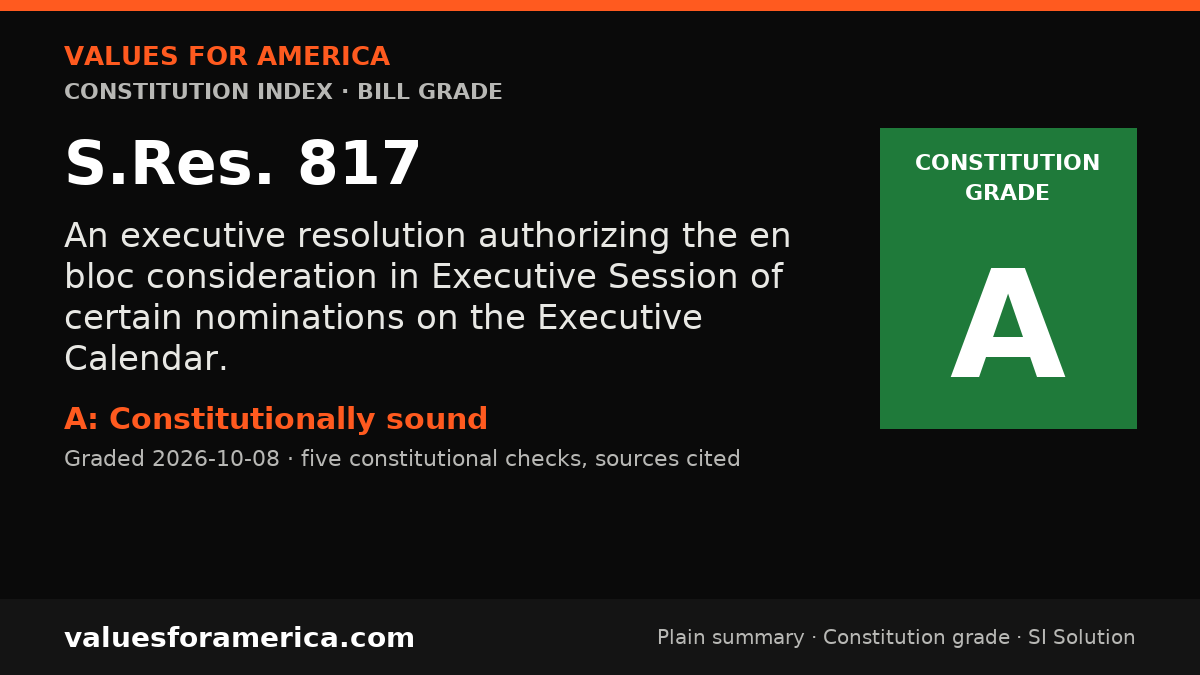
An executive resolution authorizing the en bloc consideration in Executive Session of certain nominations on the Executive Calendar.
Cosponsors: none · per Congress.gov, 2026-10-14
Introduced: 2026-07-23
Latest action (2026-07-30): Resolution agreed to in Senate without amendment by Yea-Nay Vote. 50 - 47. Record Vote Number: 217.
What S.Res. 817 does, in plain terms
This resolution provides for the en bloc consideration of nominations for various executive officers, judges, ambassadors, and related positions. Agencies in which the executive officers shall serve include the Departments of Defense, Energy, the Interior, State, and the Treasury. Additional nominees shall represent the United States to, among others, the United Nations, the Organization for Economic Cooperation and Development (OECD), Brazil, Cambodia, Cyprus, and the Gambia. Nominees are also appointed to the National Labor Relations Board, National Transportation Safety Board, Consumer Product Safety Commission, and District of Columbia (DC) courts.
Official summary by the Congressional Research Service, via Congress.gov.
Constitution Index
“VFA Constitution grade”
Constitutionally sound
Graded 2026-10-08
SI-generated grade · five published checks · not individually reviewed by a person · methodology
SRES 817 is a routine Senate rules action organizing en bloc votes on nominations, squarely authorized by Article I, Section 5 and Article II, Section 2, with no rights infringement, sovereignty restriction, centralization, or due process issue.
-
✓ Passes · Enumerated powers
The Senate has express authority to act. Article II, Section 2, Clause 2 gives the Senate the advice and consent role on nominations, and Article I, Section 5, Clause 2 gives each House power to determine the Rules of its Proceedings. An en bloc consideration resolution is a direct exercise of that rulemaking and consent authority. -
✓ Passes · Bill of Rights
No speech, religion, press, arms, search, trial, or other protection in Amendments 1-10 is restricted. The resolution only governs Senate floor procedure for nominations and imposes no restraint on private conduct. -
✓ Passes · Individual sovereignty
The resolution restricts no private person, property, speech, labor, or belief. It binds only Senators in their official voting procedure, so no individual sovereignty interest requires government justification. -
✓ Passes · Decentralization
Confirmation of federal officers, judges, and ambassadors is an inherently federal function under Article II, Section 2. Individuals, counties, and states cannot appoint federal officers or represent the United States abroad. The resolution does not move any new policy area to the federal level; it only organizes Senate procedure, so it does not consolidate upward. -
✓ Passes · Due process and takings
No person is deprived of life, liberty, or property, and no property is taken. Under the Fifth Amendment Due Process and Takings Clauses, no notice, hearing, or compensation is triggered by a Senate scheduling resolution.
Sources: Congress.gov: SRES 817 summary
Report an error in this grade
The Framers
“Founders’ Verdict”
Confidence 0.75
Archived SI output (machine-generated)No editorial review recorded. This historical SI verdict was machine-generated by software and predates the review desk; check it against the official bill text.
Synthesis
The Senate may consider nominations en bloc as a procedural rule under Article I, Section 5, Clause 2, provided that each Senator retains the right to demand separate consideration and a recorded vote on any individual nomination, thereby preserving the deliberative duty inherent in the advice and consent power under Article II, Section 2, Clause 2.
The Senate possesses the constitutional authority to determine its own rules of proceeding, including the method by which it considers nominations. Article I, Section 5, Clause 2 grants each House the power to 'determine the Rules of its Proceedings.' The en bloc consideration of nominations in Executive Session is a procedural mechanism that does not infringe upon the President's appointment power under Article II, Section 2, Clause 2, which requires the advice and consent of the Senate. The Senate may expedite its business through such rules, as the Federalist No. 66 notes the Senate's role …
The Constitution vests the Senate with the sole Power to advise and consent to nominations (Article II, Section 2, Clause 2). En bloc consideration of nominations may be permissible if it does not deprive Senators of their individual duty to deliberate on each nominee's fitness. However, if such a procedure is used to rush or obscure the examination of a nominee's character or qualifications, it would violate the spirit of the advice and consent clause, which requires a deliberate and informed judgment. The Tenth Amendment reserves to the States and the People all powers not delegated, and the…
This resolution is a procedural rule of the Senate for considering nominations. The Constitution grants each House the authority to determine its own rules of proceedings, and the Senate's power to structure its advice and consent function includes the ability to consider nominations en bloc, provided each nominee is individually subject to the final vote. The cloture motion is a legitimate exercise of the Senate's control over debate and calendar management. Nothing in the Constitution requires that nominations be considered individually or in a specific order. Therefore, this action is consi…
The Constitution vests in the Senate the sole Power to advise and consent to nominations, and Article I, Section 5 grants each House the authority to determine the Rules of its Proceedings. The en bloc consideration of nominations in Executive Session is a procedural rule that does not violate any express constitutional provision. As established in Marbury v. Madison, it is the duty of the judicial department to say what the law is, but here the action concerns internal legislative procedure, which is a political question committed to the Senate's discretion. The Necessary and Proper Clause (A…
Report an error in this Founders' Verdict
What should pass
“VFA SI Solution”
No solution yet
A sourced SI draft appears here once it passes automated checks (Constitution citation, source verification, independent SI critic). How publication works.
Related on VFA

For journalists and bloggers
“Embed this grade”
Free to use with the link back. The badge and card update when the grade changes. Embed terms →
