S.J.Res. 138 explained · 119th Congress · Pending in Congress
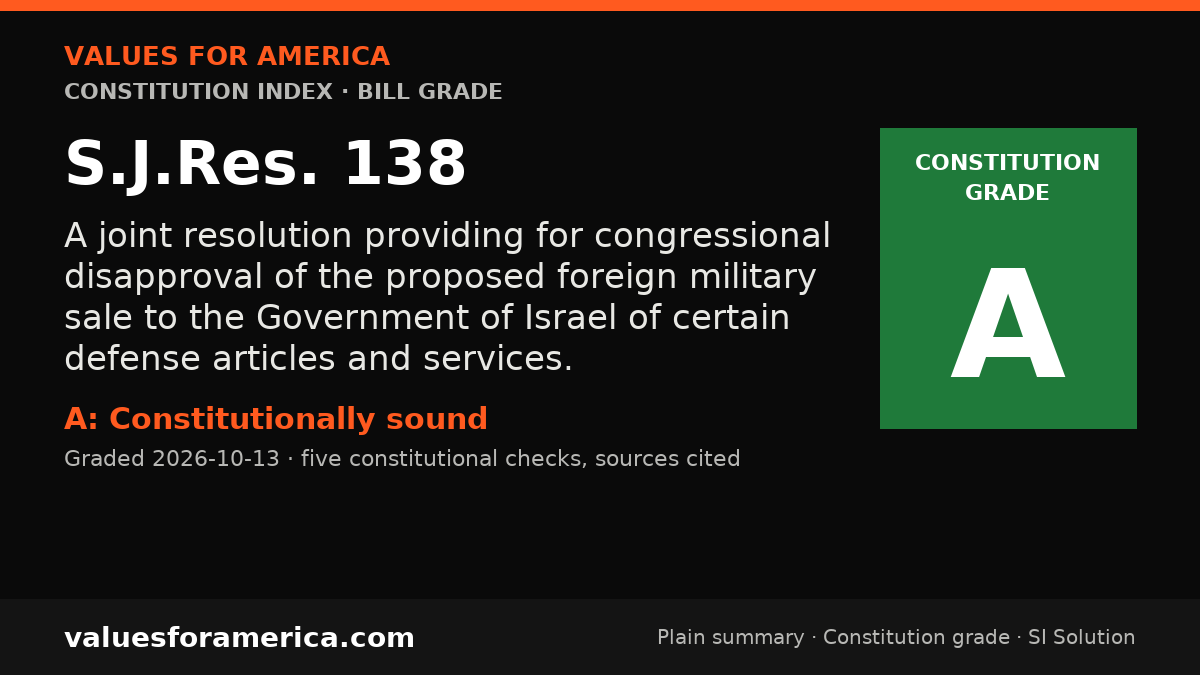
A joint resolution providing for congressional disapproval of the proposed foreign military sale to the Government of Israel of certain defense articles and services.
Cosponsors: 3 (3 D, 0 R) · per Congress.gov, 2026-10-09
Introduced: 2026-03-19
Latest action (2026-04-15): Motion to discharge Senate Committee on Foreign Relations rejected by Yea-Nay Vote. 36 - 63. Record Vote Number: 81. (consideration: CR S1779)
What S.J.Res. 138 does, in plain terms
This joint resolution prohibits a proposed foreign military sale of certain defense articles and services to Israel.
Official summary by the Congressional Research Service, via Congress.gov.
Constitution Index
“VFA Constitution grade”
Constitutionally sound
Graded 2026-10-13
SI-generated grade · five published checks · not individually reviewed by a person · methodology
The joint resolution is a valid exercise of Congress's enumerated power over foreign commerce and foreign affairs, does not infringe on any constitutional rights, and appropriately delegates decision-making to the federal level where foreign military sales are constitutionally committed. The resolution is fully constitutional.
-
✓ Passes · Enumerated powers
Congress has explicit constitutional authority over foreign commerce and foreign affairs. Article I, Section 8, Clause 3 grants Congress the power to regulate commerce with foreign nations, and Article I, Section 8, Clause 11 grants the power to declare war, which includes oversight of military sales. Additionally, the President's foreign military sales are subject to congressional approval under … -
✓ Passes · Bill of Rights
The resolution does not implicate any of the first ten amendments. It does not restrict speech, religion, assembly, press, petition, arms, quartering, search and seizure, self-incrimination, due process, takings, trial rights, or cruel and unusual punishment. The Second Amendment is not implicated because the resolution concerns a foreign military sale to a foreign government, not the rights of in… -
✓ Passes · Individual sovereignty
The resolution restricts the actions of the executive branch in conducting foreign military sales, not the actions of individuals. It does not restrict any person's use of their person, property, speech, labor, or belief. The burden of justification for restricting individual liberty is not triggered because no individual liberty is restricted. -
✓ Passes · Decentralization
The resolution concerns a foreign military sale, which is inherently a matter of national foreign policy and cannot be handled by individuals, local communities, or states. The federal government is the only level of government with constitutional authority to conduct foreign affairs. The resolution does not consolidate decision-making upward; it is already at the federal level, and Congress is ex… -
✓ Passes · Due process and takings
The resolution does not deprive any person of life, liberty, or property without due process of law, nor does it take private property for public use without just compensation. It is a legislative act of disapproval, subject to the full legislative process, including bicameral passage and presentment to the President, which satisfies procedural due process. The action is not arbitrary but is a del…
Sources: Congress.gov: SJRES 138 summary
Report an error in this grade
The Framers
“Founders’ Verdict”
Confidence 1.00
Archived SI output (machine-generated)No editorial review recorded. This historical SI verdict was machine-generated by software and predates the review desk; check it against the official bill text.
Synthesis
Unanimous: Congress's enumerated powers to regulate commerce with foreign nations (Art. I §8 Cl.3), provide for common defense, and appropriate funds authorize joint resolutions disapproving specific foreign military sales, balancing separation of powers without encroaching on executive diplomacy.
Congress holds explicit authority to regulate commerce with foreign nations and to make appropriations for the common defense, powers which extend to the oversight and regulation of military sales and defense articles to foreign governments. A joint resolution disapproving a specific foreign military sale constitutes a legitimate exercise of legislative prerogative in these domains, checking executive action without encroaching upon the President's conduct of diplomacy, as such sales involve commercial transactions and fiscal commitments subject to congressional control. This balances the sepa…
The Congress possesses enumerated powers to regulate commerce with foreign nations and to make appropriations for the common defense, which encompass the authority to approve or disapprove the export of arms and military articles. A joint resolution disapproving a specific foreign military sale operates within these bounds, as it directs the execution of prior laws governing such transactions and controls the use of public funds. This strict construction limits federal action to delegated powers, preserving the reservation of undelegated authority to the States or the people.
The proposed joint resolution falls within the enumerated powers of Congress to regulate commerce with foreign nations, which necessarily includes the disposition of arms and military articles destined for export. Such regulation prevents the disorders of unregulated foreign intercourse observed in confederacies past, while the power to provide for the common defense empowers Congress to oversee military sales that implicate national security. This legislative check aligns with the separation of powers, as the President may veto, preserving equilibrium without vesting unchecked authority in th…
The proposed joint resolution exercises Congress's enumerated powers to regulate commerce with foreign nations and to provide for the common defense through oversight of military sales. Such disapproval is a means reasonably related to executing these powers, as Congress holds the authority to prescribe the terms upon which arms may be exported. The Constitution vests in Congress the primary responsibility for matters touching upon war and foreign intercourse, subject to the President's execution thereof, but not to the exclusion of legislative checks. This action does not infringe upon execut…
Report an error in this Founders' Verdict
What should pass
“VFA SI Solution”
No solution yet
A sourced SI draft appears here once it passes automated checks (Constitution citation, source verification, independent SI critic). How publication works.
Related on VFA

For journalists and bloggers
“Embed this grade”
Free to use with the link back. The badge and card update when the grade changes. Embed terms →
