S. 4161 explained · 119th Congress · Pending in Congress
Maverick Act
Cosponsors: 1 (1 D, 0 R) · per Congress.gov, 2026-10-14
Introduced: 2026-03-23
Latest action (2026-05-04): Held at the desk.
What S. 4161 does, in plain terms
Maverick Act This bill authorizes the Department of the Navy to transfer three surplus F-14D Tomcat aircraft to the U.S. Space and Rocket Center Commission in Huntsville, Alabama. (The F-14D Tomcat was a naval fighter aircraft that was retired from service in 2006.) The bill provides for certain conditions for the transfer, including that the transfer must be free of cost to the federal government. Additionally, the commission must not convey ownership interest in the aircraft to another party without Navy approval. If the commission breaches any conditions, the aircraft must revert to the United States. The bill also specifies that such aircraft may not have any combat capability. The Navy may provide excess spare parts to the commission to make one of the aircraft flyable or complete for a static display. The Navy may authorize the commission to enter into agreements with qualified nonprofit organizations to restore and operate the aircraft for public display, air shows, and commemorative events.
Official summary by the Congressional Research Service, via Congress.gov.
Constitution Index
“VFA Constitution grade”
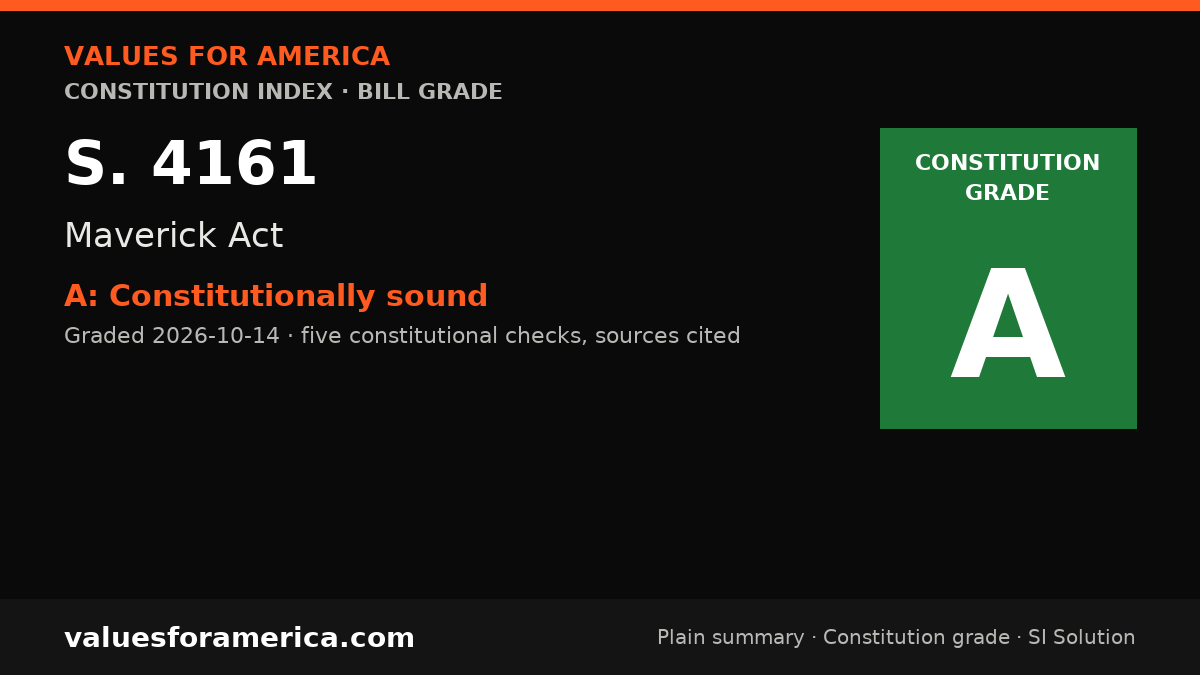
Constitutionally sound
Graded 2026-10-14
SI-generated grade · five published checks · not individually reviewed by a person · methodology
The Maverick Act is fully constitutional. It involves a routine property transfer of surplus military aircraft to a museum commission, with no infringement on individual rights, no expansion of federal power beyond enumerated authority, and no due process or takings issues. The bill respects decentralization by leaving the transfer to local management and imposes only standard conditions to protect federal property interests.
-
✓ Passes · Enumerated powers
Congress has explicit authority under Article I, Section 8, Clause 14 to 'make Rules for the Government and Regulation of the land and naval Forces,' which includes disposing of surplus military property. The transfer of retired F-14D aircraft to a museum commission falls squarely within this power, as it relates to the management and disposition of naval assets. No overreach occurs. -
✓ Passes · Bill of Rights
The bill does not regulate speech, religion, assembly, press, petition, arms, quartering, search and seizure, self-incrimination, due process, fair trial, jury, cruel punishment, or any other right protected by the first ten amendments. It merely authorizes a property transfer with conditions. No rights are implicated. -
✓ Passes · Individual sovereignty
The bill imposes no restrictions on individual conduct, property, speech, labor, or belief. It does not command, prohibit, or penalize any person. The conditions apply only to a government commission receiving federal property, which is a standard contractual arrangement. Individual sovereignty is untouched. -
✓ Passes · Decentralization
The transfer is to a local commission in Huntsville, Alabama, which will manage the aircraft for public display and commemorative events. An individual or family could not handle this (the aircraft are large military assets), but a local commission can. No state or federal involvement is required beyond the initial transfer. The bill does not consolidate decision-making upward; it devolves control… -
✓ Passes · Due process and takings
The bill does not take any private property; it transfers government-owned surplus property to a commission. There is no deprivation of life, liberty, or property without due process. The conditions (free transfer, no unauthorized conveyance, reversion upon breach) are standard and do not implicate the Fifth Amendment. No hearing or notice is required because no individual right is affected.
Sources: Congress.gov: S 4161 summary
Report an error in this grade
The Framers
“Founders’ Verdict”
Confidence 0.50
Archived SI output (machine-generated)No editorial review recorded. This historical SI verdict was machine-generated by software and predates the review desk; check it against the official bill text.
Synthesis
Falls squarely within Congress's enumerated powers to provide for common defense, raise/support armies, maintain navy, and regulate forces (Hamilton, Marshall).
Legislation concerning Armed Forces and National Security falls squarely within the enumerated powers of Congress to provide for the common defence, to raise and support Armies, to provide and maintain a Navy, and to make Rules for the Government and Regulation of the land and naval Forces. Such measures are essential to the preservation of the Union against external dangers, as the energetic execution of these powers ensures national security without dependence on uncertain state militias.
The Constitution grants Congress explicit authority to provide for the common defense by raising and supporting armies, maintaining a navy, and regulating the land and naval forces. However, any legislation styled the Maverick Act in the realm of armed forces and national security must strictly adhere to these enumerated powers without encroaching upon the rights of the states or individuals. It is constitutional only insofar as it does not compel quartering of soldiers in private homes or infringe upon the right to keep and bear arms essential to a free state, with all else reserved to the st…
Legislation concerning armed forces and national security falls within the enumerated powers of Congress to declare war, raise and support armies, provide and maintain a navy, and make rules for their governance, provided it adheres strictly to these limits and does not infringe on state prerogatives or extend beyond careful enumeration. Without the full text, constitutionality depends on whether the 'Maverick Act' respects the two-year limit on army appropriations and avoids undue concentration of military power that could endanger republican liberty, as discussed in the analysis of these pro…
The Maverick Act, pertaining to Armed Forces and National Security, falls within the enumerated powers of Congress to provide for the common defence, raise and support Armies, and maintain a Navy, as granted by the Constitution. This legislative action is a means necessary and proper to execute these powers, consistent with the framework of implied powers essential to the execution of express constitutional grants. Judicial review affirms the supremacy of the Constitution, yet defers to legislative discretion in matters of national defence where powers are plainly conferred.
Report an error in this Founders' Verdict
What should pass
“VFA SI Solution”
Archived SI output (machine-generated) · No editorial review recorded
This historical draft has no editorial review time on record. Check its claims against the original bill and current law.
Maverick Defense Enhancement Act of 2025
Generated by VFA SI Solutions
The Maverick Act authorizes enhancements to U.S. armed forces capabilities, including new units or programs for rapid response and innovation in national security, to provide for the common defense.
Bipartisan rationale: Honors Democratic priorities of investing in modern national security against cyber and hypersonic threats; honors Republican priorities of fiscal restraint via reallocation and hard caps, strong congressional oversight, and sunset to prevent permanent bureaucracy.
Article I, Section 8, Clause 12 Article I, Section 8, Clause 13 Article I, Section 8, Clause 14 Article I, Section 8, Clause 1 Amendment V
Report an error in this Solution
Citizen Consensus
“Do you support this VFA SI Solution?”
One vote per verified account; you can change it any time. Only verified accounts count, results publish once 30 verified people have voted, and state and district results count only people who attested a home ZIP code. How this works.
Email verification is not switched on yet, so no vote counts toward results yet. Votes cast now are saved and count once the voter verifies their email address.
Sign in or create a free account to vote.
Add a short reason (optional)
/280 · no links or contact details · reasons are reviewed before anyone sees them, and many never are shown.
Your vote is saved but held out of published results by an automated integrity check (for example, several accounts voting from one browser).
Your vote is saved. It will count once you verify your email address. Verify on your account page.
Your vote counts nationally. Add your home ZIP code to count in your state and district too.
Your vote counts nationally and in .
Reason saved privately; it is shown only if it passes review.
Verified participants nationwide · n =
Self-selected participants, not a random sample; ± is the 95% sampling margin.
Not enough verified votes yet. Results publish at verified votes.
A sudden surge of votes on this item was flagged and is under review; votes from new accounts in that surge are held out until it is resolved.
Related on VFA

For journalists and bloggers
“Embed this grade”
Free to use with the link back. The badge and card update when the grade changes. Embed terms →
