H.R. 8790 explained · 119th Congress · Pending in Congress
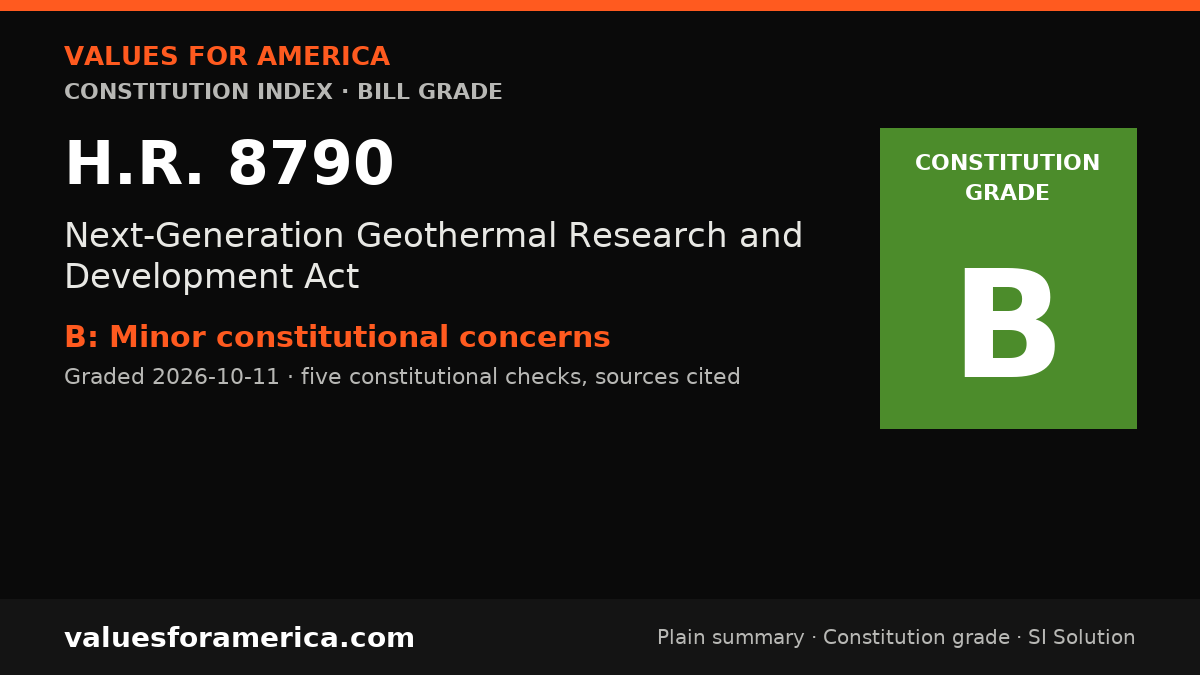
Next-Generation Geothermal Research and Development Act
Cosponsors: 1 (1 D, 0 R) · per Congress.gov, 2026-10-15
Introduced: 2026-05-13
Latest action (2026-07-21): Received in the Senate and Read twice and referred to the Committee on Energy and Natural Resources.
What H.R. 8790 does, in plain terms
Next-Generation Geothermal Research and Development Act This bill directs the Department of Energy (DOE) to support the development of next-generation geothermal systems, such as closed-loop geothermal systems in supercritical conditions. Specifically, the bill expands the Energy Independence and Security Act of 2007 to modify and establish geothermal energy programs, such as programs concerning research and development, grants, and data management. DOE must support a program of research, development, demonstration, and commercial application for next-generation geothermal systems. DOE may administer grants for carrying out certain focus areas of the program. DOE must also ensure that at least one Frontier Observatory for Research in Geothermal Energy (FORGE) field research site has the capabilities to include next-generation geothermal testing. Additionally, DOE must provide grants for (1) the continuation and expansion of research, development, demonstration, testing, and commercial application activities applicable to FORGE sites; and (2) the establishment of a next-generation geothermal systems center of excellence. DOE must also provide grants to accelerate the development, testing, and implementation of innovative technologies to improve the commercial-readiness of geothermal energy projects using next-generation geothermal systems. DOE must expand its repository of geothermal drilling information to include publicly available subsurface data, including data reported as part of fossil fuel and mining operations. DOE must also periodically update the repository to improve its functionality and usability. The bill authorizes the Department of the Interior to commission the drilling of supercritical geothermal exploration boreholes in certain areas to provide control points for deep heat mapping and geothermal development.
Official summary by the Congressional Research Service, via Congress.gov.
Constitution Index
“VFA Constitution grade”
Minor constitutional concerns
Graded 2026-10-11
SI-generated grade · five published checks · not individually reviewed by a person · methodology
The bill is a federal energy research and development program that falls within Congress's enumerated powers under the Spending Clause and Commerce Clause. It does not infringe on individual rights, and it does not take property or bypass due process. However, it consolidates significant decision-making and funding at the federal level, which raises decentralization concerns, though it does not directly violate the Tenth Amendment.
-
✓ Passes · Enumerated powers
Congress has authority under Article I, Section 8, Clause 1 (Spending Clause) to appropriate funds for the general welfare, which includes energy research and development. Additionally, Article I, Section 8, Clause 3 (Commerce Clause) supports federal involvement in energy markets and interstate commerce. The bill directs federal agencies to conduct research, provide grants, and manage data, all o… -
✓ Passes · Bill of Rights
The bill does not implicate any of the first ten amendments. It does not restrict speech, religion, assembly, press, petition, arms, quartering, search and seizure, self-incrimination, due process, takings, trial rights, or cruel and unusual punishment. The data repository expansion involves publicly available data and does not compel private disclosure in a manner that would violate the Fourth or… -
✓ Passes · Individual sovereignty
The bill imposes no direct restrictions on individual liberty. It creates voluntary grant programs and research initiatives. Individuals and private entities are not compelled to participate, and the bill does not regulate personal conduct, property use, or labor. The burden of justification for any indirect effects is met by the public interest in energy research and development. -
✗ Concern · Decentralization
The bill fails the decentralization test because it consolidates decision-making and funding at the federal level. While individuals and local communities cannot easily conduct supercritical geothermal research, states could potentially handle such research with their own resources. The federal government's role is not the minimum necessary, as the bill centralizes program administration, grant di… -
✓ Passes · Due process and takings
The bill does not deprive any person of life, liberty, or property without due process. It does not impose penalties or take private property. The authorization for the Department of the Interior to commission drilling is for exploration boreholes in certain areas, which may involve federal lands, but the bill does not authorize taking private property without just compensation. Any such actions w…
Sources: Congress.gov: HR 8790 summary
Report an error in this grade
The Framers
“Founders’ Verdict”
Confidence 0.75
Archived SI output (machine-generated)No editorial review recorded. This historical SI verdict was machine-generated by software and predates the review desk; check it against the official bill text.
Synthesis
The bill is constitutional under the Spending Clause, Commerce Clause, Property Clause, and Necessary and Proper Clause, as it promotes the general welfare, regulates interstate commerce, and manages federal lands without infringing on state sovereignty.
This bill is a constitutional exercise of the powers of Congress. The primary authority lies in the Spending Clause, which empowers Congress to lay and collect taxes to provide for the general welfare. The authorization of grants and research programs for geothermal energy falls squarely within that broad power, as it promotes the general welfare by advancing domestic energy resources and national economic independence. Additionally, the bill's provisions regarding the Department of the Interior’s drilling on federal lands are supported by the Property Clause, which grants Congress the power t…
The Constitution enumerates only limited powers to the federal government. The Tenth Amendment reserves all powers not delegated to the United States to the states or the people. This bill authorizes the Department of Energy and the Department of the Interior to engage in research, development, grants, and data collection for next-generation geothermal systems. Such activities are not among the enumerated powers in Article I, Section 8. The Commerce Clause does not extend to purely intrastate energy research, and the General Welfare Clause does not authorize specific internal improvements of t…
The bill is constitutional under the Commerce Clause and the General Welfare Clause. The development of geothermal energy resources directly affects interstate commerce in energy, and the federal government has a legitimate interest in supporting research and development that promotes the general welfare. The grants and programs authorized by the bill are exercises of the spending power, which is broad and not limited to specific enumerated objects, so long as the spending is for the general welfare. Additionally, the involvement of the Department of the Interior in drilling boreholes on certa…
This bill falls squarely within the enumerated powers of Congress. The promotion of geothermal energy research and development is a regulation of commerce among the several states, as energy markets and technological innovation inherently affect interstate commerce. The Necessary and Proper Clause authorizes Congress to establish programs and grant funds to achieve legitimate ends of the commerce power. Furthermore, the authorization for the Department of the Interior to drill on federal lands is a valid exercise of the Property Clause, which grants Congress plenary authority over territories …
Report an error in this Founders' Verdict
What should pass
“VFA SI Solution”
No solution yet
A sourced SI draft appears here once it passes automated checks (Constitution citation, source verification, independent SI critic). How publication works.
Related on VFA

For journalists and bloggers
“Embed this grade”
Free to use with the link back. The badge and card update when the grade changes. Embed terms →
