H.R. 8658 explained · 119th Congress · Pending in Congress
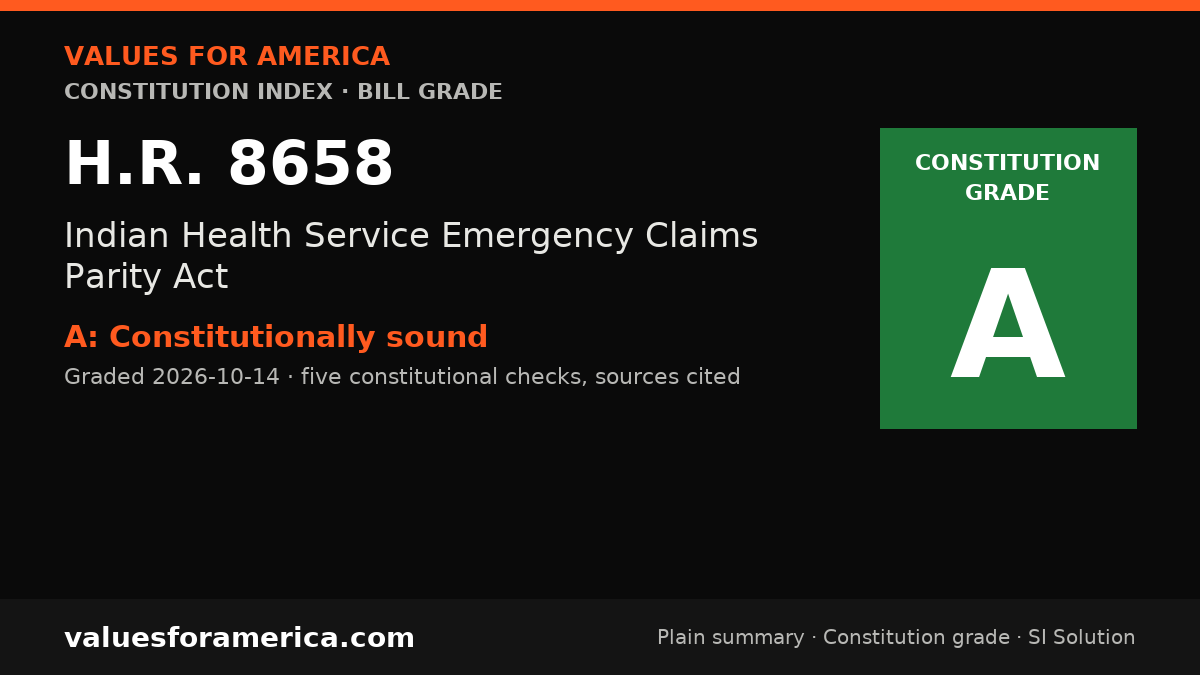
Indian Health Service Emergency Claims Parity Act
Cosponsors: 1 (0 D, 1 R) · per Congress.gov, 2026-10-14
Introduced: 2026-05-04
Latest action (2026-09-15): Received in the Senate.
What H.R. 8658 does, in plain terms
Indian Health Service Emergency Claims Parity Act This bill extends from 72 hours to not less than 15 days the time period to notify the Purchased/Referred Care (PRC) program of emergency medical care received from a non-Indian Health Service (IHS) medical provider or at a non-IHS medical facility. This bill does not apply to individuals who are elderly or disabled, who continue to have a 30-day notification requirement for emergency services. The IHS provides medical and dental services directly to American Indian and Alaska Native patients whenever possible. The PRC program pays for medical or dental care that is provided away from an IHS or tribal health care facility. The PRC program must be notified of requests for authorization of payment for health care services from a non-IHS provider. Currently in emergency cases, the patient, an individual on behalf of the patient, or the medical care provider must, within 72 hours after the beginning of treatment for the condition or after admission to a health care facility, notify a PRC authorizing official of the need for the emergency medical care. This bill instead allows the patient, other individual, or provider to notify PRC not less than 15 days of the treatment or admission.
Official summary by the Congressional Research Service, via Congress.gov.
Constitution Index
“VFA Constitution grade”
Constitutionally sound
Graded 2026-10-14
SI-generated grade · five published checks · not individually reviewed by a person · methodology
This bill is a straightforward administrative adjustment to the notification deadline for emergency medical care under the Indian Health Service's Purchased/Referred Care program. It does not expand federal power beyond existing authority, does not infringe on any constitutional rights, and does not centralize decision-making. It is fully consistent with the Constitution.
-
✓ Passes · Enumerated powers
The federal government has long-standing authority over Indian affairs under Article I, Section 8, Clause 3 (the Indian Commerce Clause), and the treaty power. The Indian Health Service operates under this authority, and adjusting the notification period for its Purchased/Referred Care program is a valid exercise of that enumerated power. The bill does not create new federal authority but merely m… -
✓ Passes · Bill of Rights
The bill does not implicate any of the first ten amendments. It does not restrict speech, religion, assembly, press, petition, arms, quartering, search and seizure, self-incrimination, due process, takings, trial rights, or cruel and unusual punishment. It is a purely procedural change to a federal health care program's notification requirement. -
✓ Passes · Individual sovereignty
The bill does not restrict individual liberty. It actually extends the time period for individuals to notify the PRC program of emergency care, which reduces the burden on individuals and providers. It does not compel any action beyond what is already required, and it does not restrict personal property, labor, or belief. The change is beneficial to individuals and does not require a compelling go… -
✓ Passes · Decentralization
The bill does not consolidate decision-making at a higher level of government. It applies to a federal program that already exists and is administered at the federal level. The change is administrative and does not shift authority from states or localities to the federal government. The four-question test: (1) Individuals cannot handle this alone because it involves federal health care funding; (2… -
✓ Passes · Due process and takings
The bill does not deprive anyone of life, liberty, or property without due process. It does not take property without just compensation. It extends the notification deadline, which is a procedural change that does not affect the substantive rights of patients or providers. There is no arbitrary government action; the change is a reasonable adjustment to accommodate emergency circumstances.
Sources: Congress.gov: HR 8658 summary
Report an error in this grade
The Framers
“Founders’ Verdict”
Confidence 1.00
Archived SI output (machine-generated)No editorial review recorded. This historical SI verdict was machine-generated by software and predates the review desk; check it against the official bill text.
Synthesis
Unanimous affirmation: Congress holds express authority under the Commerce Clause to regulate affairs with Indian Tribes, including amendments to health services notification requirements.
Congress possesses the express authority to regulate Commerce with the Indian Tribes, which encompasses the provision and administration of health services to tribal members through contractual arrangements. Amending prior legislation to adjust notification requirements for emergency services falls squarely within this power, as it pertains to the orderly execution of federal duties toward the Tribes. Such measures are essential to the efficacious management of Indian affairs, a domain reserved to the general government to prevent the discord that would arise from state intermeddling.
The proposed amendment pertains to health services for certain beneficiaries under federal authority over Indian affairs, a power expressly delegated to Congress. The Constitution grants Congress the authority 'To regulate Commerce ... with the Indian Tribes,' encompassing relations and provisions for tribes as understood in the founding era. This modification to notification requirements for emergency services falls within that enumerated power and does not exceed strict construction of federal limits. The Tenth Amendment reserves undelegated powers to the States or people, but here the power…
Congress possesses an enumerated power to regulate Commerce with the Indian Tribes, as expressly granted. This bill amends an existing Act to adjust notification requirements for emergency health services provided under contract to certain beneficiaries within that sphere of regulation. Such modification falls within the authority to make needful rules and regulations implementing the commerce power, preserving the careful enumeration of federal powers while addressing practical administration without encroaching upon the reserved rights of the States.
The proposed amendment to the Indian Health Care Improvement Act, modifying notification requirements for emergency contract health services for certain beneficiaries, falls within the express powers of Congress. The Constitution grants Congress authority 'To regulate Commerce...with the Indian Tribes,' enabling legislation concerning the health and welfare of Indian beneficiaries as a proper regulation of tribal affairs. Such amendments are moreover a means 'plainly adapted' to legitimate ends, within the necessary and proper clause, as they facilitate the execution of enumerated powers witho…
Report an error in this Founders' Verdict
What should pass
“VFA SI Solution”
No solution yet
A sourced SI draft appears here once it passes automated checks (Constitution citation, source verification, independent SI critic). How publication works.
Related on VFA

For journalists and bloggers
“Embed this grade”
Free to use with the link back. The badge and card update when the grade changes. Embed terms →
