H.R. 8464 explained · 119th Congress · Pending in Congress
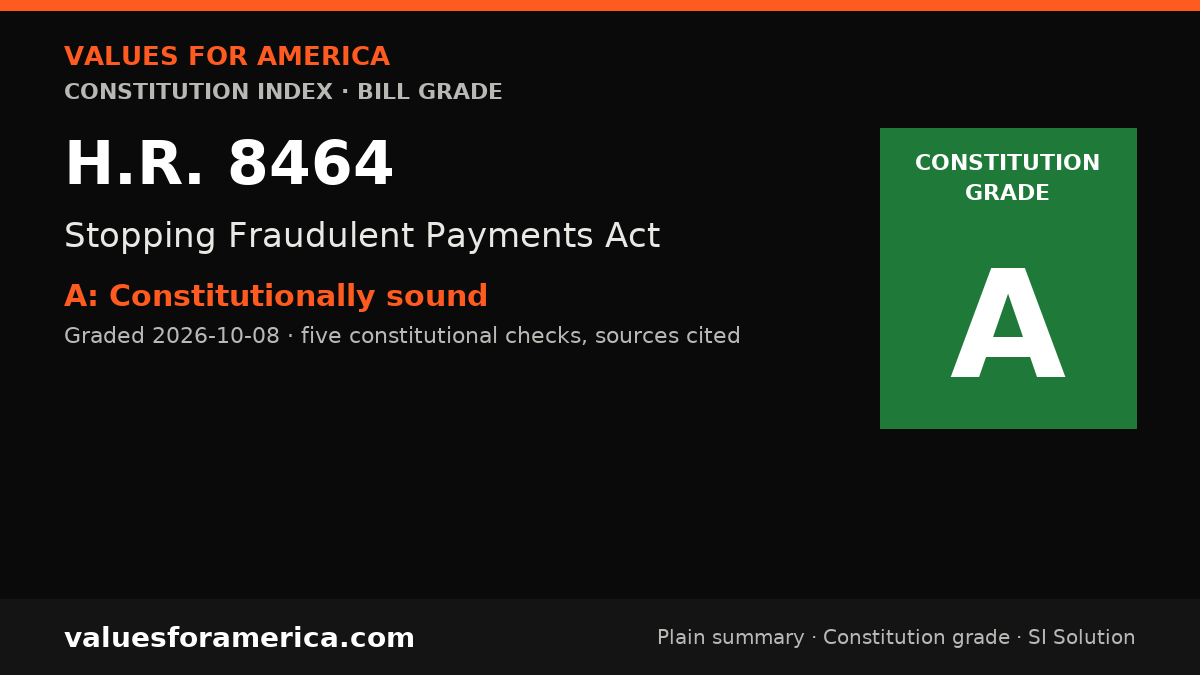
Stopping Fraudulent Payments Act
Cosponsors: 2 (0 D, 2 R) · per Congress.gov, 2026-10-08
Introduced: 2026-04-23
Latest action (2026-06-11): Received in the Senate.
What H.R. 8464 does, in plain terms
Stopping Fraudulent Payments Act This bill establishes requirements to prevent fraudulent or improper payments from federal programs. Specifically, the bill directs executive agencies to take corrective actions to temporarily pause, condition, or segment payment voucher requests before certifying them if the agencies have sufficient reason to determine that the payments present elevated risks of fraud or improper payments resulting in financial loss to the government. The corrective actions must be (1) based on objective, documented fraud-risk indicators; (2) narrowly applied to the portion of the payments presenting the elevated risk; and (3) limited in duration to the minimum period necessary to verify the eligibility or accuracy of the payments. The Department of the Treasury must return certified payment vouchers to agencies for corrective action if they present an elevated risk of fraud based on an output of Treasury’s Do Not Pay system. The bill also prohibits officers or employees of the federal government from being personally liable for actions taken in good faith under this bill.
Official summary by the Congressional Research Service, via Congress.gov.
Constitution Index
“VFA Constitution grade”
Constitutionally sound
Graded 2026-10-08
SI-generated grade · five published checks · not individually reviewed by a person · methodology
This bill manages federal spending with temporary, documented, narrow, time-limited fraud checks under Article I, Section 8, Clauses 1 and 18. It touches no right in the Bill of Rights, imposes no restriction on personal sovereignty, stays at the proper federal disbursing level, and preserves due process while creating no permanent property taking.
-
✓ Passes · Enumerated powers
Congress has express power to tax and spend for the general welfare under Article I, Section 8, Clause 1, and to make laws necessary and proper to execute that power under Article I, Section 8, Clause 18. Directing agencies and Treasury to screen, pause briefly, and verify federal payment vouchers for fraud is a direct exercise of stewardship over federal spending, not a regulation of matters rese… -
✓ Passes · Bill of Rights
No provision of the first ten amendments is infringed. The pause is temporary, risk-based, narrowly applied, and time-limited for eligibility verification only, so it does not abridge speech under the First Amendment, does not authorize search or seizure beyond routine funds administration under the Fourth Amendment, and does not deny a protected liberty or property interest under the Fifth Amendm… -
✓ Passes · Individual sovereignty
The bill does not restrict a person in use of their own person, property, speech, labor, or belief. It governs internal federal payment certification only. Any delay to a payee is incidental, temporary, bounded to the risky portion, and justified by the compelling interest in preventing loss of public funds, with eligibility verification as the release condition. The burden remains on the governme… -
✓ Passes · Decentralization
The subject is disbursement of federal funds already authorized by federal law. An individual, county, or state cannot verify and certify federal payment vouchers or operate the Treasury Do Not Pay system in place of the disbursing federal agency. The bill keeps action at the minimum necessary level by requiring narrow scope, objective indicators, and minimum duration, and it does not move non-fed… -
✓ Passes · Due process and takings
No benefit is terminated without standards or review; payment is briefly paused, conditioned, or segmented while eligibility is verified, based on documented fraud-risk indicators, with prompt Treasury return procedures. That satisfies procedural due process under the Fifth Amendment requiring fair notice and non-arbitrary action, preserves presumption of innocence because no criminal liability is…
Sources: Congress.gov: HR 8464 summary
Report an error in this grade
The Framers
“Founders’ Verdict”
Confidence 0.50
Archived SI output (machine-generated)No editorial review recorded. This historical SI verdict was machine-generated by software and predates the review desk; check it against the official bill text.
Synthesis
The bill is constitutional only if implemented with strict adherence to objective fraud indicators, due process safeguards, and without infringing on executive discretion or state powers.
The bill is a proper exercise of Congress's power under Article I, Section 8, Clause 1 to provide for the general welfare and to ensure that public funds are disbursed only for authorized purposes. The requirement that executive agencies pause or condition payments based on objective fraud indicators is a necessary regulation of the Treasury's payment process, consistent with Congress's power to make all laws which shall be necessary and proper for carrying into execution the powers vested in the government (Article I, Section 8, Clause 18). The prohibition on personal liability for good-faith…
The bill's purpose of preventing fraud is laudable, but its means raise serious concerns under the Constitution. The Tenth Amendment reserves to the States or the people all powers not delegated to the United States. The federal government possesses only enumerated powers, and the general police power to prevent fraud is not among them. However, the Spending Clause (Article I, Section 8, Clause 1) does grant Congress power to pay the debts and provide for the general welfare, which may include measures to ensure that federal funds are not misappropriated. The bill's provisions directing execut…
This bill directs executive agencies to take corrective actions based on objective, documented fraud-risk indicators and limits those actions narrowly in scope and duration. It thus aligns with the constitutional duty of the President to 'take Care that the Laws be faithfully executed' (Article II, Section 3) while respecting the separation of powers by not aggrandizing executive discretion beyond necessary checks. Furthermore, the requirement that Treasury return vouchers for corrective action before payment is a proper exercise of Congress's power to 'make all Laws which shall be necessary a…
This bill, in its essence, seeks to empower executive agencies to withhold or condition payments based on fraud-risk indicators. The Constitution vests in Congress the power of the purse, and the executive is bound to execute the laws faithfully. However, the bill's provisions must be examined under the necessary and proper clause and the principle of separation of powers. If the bill merely provides a framework for the executive to exercise discretion in preventing fraud—a legitimate governmental interest—and does not delegate legislative power or violate the principle that the executive must…
Report an error in this Founders' Verdict
What should pass
“VFA SI Solution”
No solution yet
A sourced SI draft appears here once it passes automated checks (Constitution citation, source verification, independent SI critic). How publication works.
Related on VFA

For journalists and bloggers
“Embed this grade”
Free to use with the link back. The badge and card update when the grade changes. Embed terms →
