H.R. 8352 explained · 119th Congress · Pending in Congress
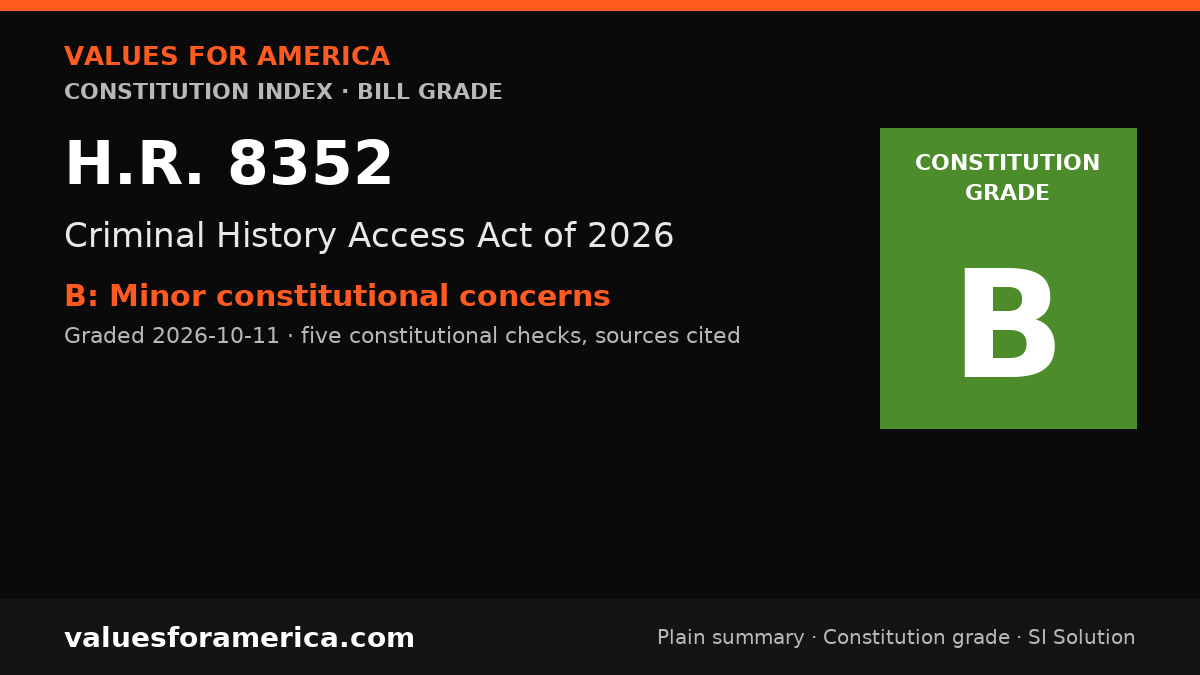
Criminal History Access Act of 2026
Cosponsors: 1 (1 D, 0 R) · per Congress.gov, 2026-10-14
Introduced: 2026-04-16
Latest action (2026-10-14): Message on Senate action sent to the House.
What H.R. 8352 does, in plain terms
Criminal History Access Act of 2026 This bill authorizes a new type of entity—peace officer standards and training agencies—to access criminal history record information maintained by the Federal Bureau of Investigation. The term peace officer standards and training agency means an agency of a state, the District of Columbia, or a U.S. territory that is authorized to set standards for the hiring, training, ethical conduct, and retention of its law enforcement officers through certification, licensing, or other similar qualification processes.
Official summary by the Congressional Research Service, via Congress.gov.
Constitution Index
“VFA Constitution grade”
Minor constitutional concerns
Graded 2026-10-11
SI-generated grade · five published checks · not individually reviewed by a person · methodology
The bill is a modest federal authorization that expands access to FBI criminal history records for state peace officer standards and training agencies. It does not itself restrict rights or expand federal enforcement power, but it raises minor federalism and privacy concerns that are fixable with additional safeguards.
-
✓ Passes · Enumerated powers
The federal government has authority to regulate interstate commerce and to manage federal criminal records. The FBI's criminal history records are federal property, and Congress has authority under Article I, Section 8, Clause 3 (Commerce Clause) to authorize access to these records for state agencies. This is a permissible use of federal power over federal information systems. -
✓ Passes · Bill of Rights
The bill does not directly infringe on any enumerated right in the Bill of Rights. It does not restrict speech, religion, assembly, press, petition, arms, quartering, search and seizure, self-incrimination, due process, trial rights, jury rights, cruel and unusual punishment, or unenumerated rights. The access to criminal history records is for official law enforcement certification purposes, not … -
✗ Concern · Individual sovereignty
The bill expands government access to personal criminal history information, which implicates individual privacy and the right to control one's personal information. While the government has a compelling interest in ensuring law enforcement officers are qualified, the bill does not include explicit safeguards for data minimization, retention limits, or individual notice and correction rights. This… -
✗ Concern · Decentralization
The bill fails the decentralization test on one question: it consolidates decision-making at the federal level by requiring state agencies to access FBI-maintained records rather than allowing states to maintain and use their own records. However, the bill does not prevent states from using their own systems, and it does not preempt state law. The federal role is limited to authorizing access to f… -
✓ Passes · Due process and takings
The bill does not deprive any person of life, liberty, or property without due process. It does not impose penalties or take property. It merely authorizes access to records for certification purposes. However, the lack of explicit procedural safeguards for individuals whose records are accessed (e.g., notice and opportunity to correct errors) is a minor due process concern, but not a violation on…
Sources: Congress.gov: HR 8352 summary
Report an error in this grade
The Framers
“Founders’ Verdict”
Confidence 0.75
Archived SI output (machine-generated)No editorial review recorded. This historical SI verdict was machine-generated by software and predates the review desk; check it against the official bill text.
Synthesis
Congress has authority under enumerated powers (including defining offenses against laws of nations, piracies, felonies on high seas, counterfeiting, and commerce) and the Necessary and Proper Clause to maintain federal criminal history records and authorize regulated access by state peace officer standards agencies, promoting coordination without usurping state powers.
The Congress possesses the authority to maintain records of criminal history generated in the execution of federal laws, particularly those concerning offenses against the laws of nations, piracies, felonies on the high seas, and counterfeiting, as enumerated in the Constitution. Authorizing state peace officer standards and training agencies to access such federal records is a proper regulation incidental to the management of these records and the faithful execution of federal powers, ensuring coordination in the administration of justice without usurping state police powers. This measure ali…
The Constitution grants no enumerated power to Congress to establish or maintain a central repository of criminal history records, especially those derived from state prosecutions, nor to authorize dissemination of such records to state agencies overseeing peace officer training. This action exceeds federal authority, intruding upon powers reserved to the States or the people. It further endangers the security of personal papers and effects against general inquisitions into private conduct, absent specific warrants tailored to individual cases.
The maintenance of criminal history record information by the Federal Bureau of Investigation falls within the implied powers of Congress to execute its enumerated authorities, such as those concerning commerce among the states and the punishment of counterfeiting and piracies. Authorizing agencies of the states, District of Columbia, or territories—responsible for standards of their own peace officers—to access such federal records facilitates cooperation between the general and local governments without encroaching upon the reserved powers of the states. This arrangement preserves the federa…
The Congress possesses the authority under the Constitution to establish departments of government and to regulate the access to records maintained by such departments for the execution of its enumerated powers. The Federal Bureau of Investigation, as a creation of Congress, maintains criminal history records incidental to the national government's execution of laws respecting interstate commerce and the apprehension of offenders therein. Authorizing state peace officer standards and training agencies to access such records constitutes a means plainly adapted to a legitimate end, namely, the p…
Report an error in this Founders' Verdict
What should pass
“VFA SI Solution”
No solution yet
A sourced SI draft appears here once it passes automated checks (Constitution citation, source verification, independent SI critic). How publication works.
Related on VFA

For journalists and bloggers
“Embed this grade”
Free to use with the link back. The badge and card update when the grade changes. Embed terms →
